Industries · Cleaning
Cleaning company marketing: residential and commercial are two funnels.
A homeowner booking a Tuesday clean and a property manager bidding out a 40,000 square foot building are not the same customer. They call for different reasons, decide on different timelines, and most cleaning websites make them read the exact same page.
The short answer
What we actually fix first: 2 funnels sharing 1 brand.
Residential and commercial cleaning share a supply closet and nothing else. One is a homeowner picking a day next week. The other is a facilities manager running a bid against three vendors. Different budgets, different questions, different sales cycles. Splitting them apart is usually the single biggest change we make.
The residential side moves fast. Somebody decides on a Thursday evening, wants a price range and a bookable slot, and closes the loop in one sitting. Every extra form field between them and a booked date costs you a customer who was already sold.
The commercial side is slow and worth far more per account. A property manager wants square-footage pricing, insurance limits, a W-9, and references from buildings like theirs. That buyer will never fill in a residential quote form, and should never be shown one.
Recurring contracts are the profitable half of this business, and most sites bury them under a one-time deep-clean price. Weekly and biweekly plans belong at the top of the page, with the one-time clean positioned as the way in rather than the headline product.
The honest limit: nobody wins this trade on volume alone. It gets won by splitting the two funnels properly and by covering the job-type searches most competitors never bothered to build a page for.
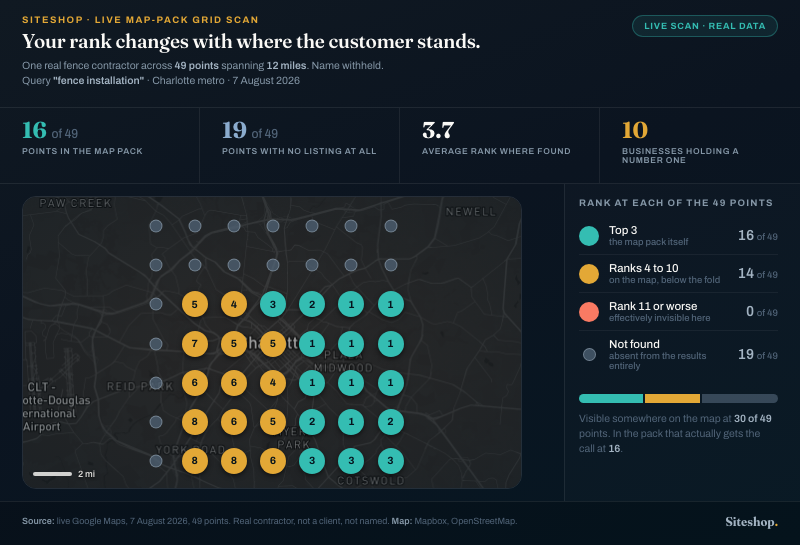
A real scan: 49 checkpoints, one live map lookup each. Green means the map pack, grey means invisible at that spot. This is how we measure the work, spot by spot, not by searching from the office chair.
Real query shapes
What your customers actually say: 6 ways the call starts.
Cleaning demand does not arrive in one voice. Move-outs, post-construction jobs, and janitorial contracts each get raised on their own terms, by people who have nothing in common except a floor that needs attention.
-
"Can you come this week?"
Residential, fast. Decided on a phone, often between other errands. A price range and an open slot wins it.
-
"We need a bid for our building."
The commercial buyer. Wants insurance limits, references, and square-footage pricing before anyone visits.
-
"We move out Friday and need the deposit back."
Deadline pressure with money riding on it. Price first, availability second, everything else third.
-
"The contractor just finished, can you clean it before we close?"
Usually a builder or a contractor, not a homeowner. A repeat account if the first job is handled well.
-
"Do you do offices, or just houses?"
A buyer sorting you into the wrong bucket. If the site does not answer this in one glance, they call the next name on the list.
-
"What would weekly cost?"
The recurring buyer telling you exactly what they want. Answer with a real number, not a callback promise.
None of these are quotes from a single call. They are the shapes we hear over and over, in a homeowner's own words and a facilities manager's own words. Building pages that answer each one directly is the work, not building one page that tries to answer all six.
What arrives
What we build for a cleaning company: 6 pieces, in this order.
- 01
Two front doors, not one
A residential route and a commercial route split at the navigation, each with its own pages, its own proof, its own contact path. This is the structural fix that makes everything after it work.
- 02
Recurring plans priced first
Weekly, biweekly, and monthly plans published with real bands, positioned ahead of the one-time deep clean. The one-time job becomes the entry point rather than the headline product.
- 03
A page per job type
Move-out, post-construction, deep clean, apartment turnover. Each is its own decision with its own urgency and its own price expectation, and each earns a page most local competitors never wrote.
- 04
A commercial page procurement can use
Insurance limits, bonding, supervision model, square-footage bands, and the building types you already service. A facilities manager needs to forward that page to someone else without adding an explanation.
- 05
Your Google profile worked every week
Categories, service area, services, photos, and questions kept current, with fresh posts going out on a set schedule. For residential cleaning searches, this profile decides more bookings than the website does.
- 06
Booking and review requests wired in
A booking flow short enough to finish standing up, plus review requests that go out while the job is still fresh. Both the count of reviews and how fast you reply to them affect who Google shows first.
Fit
Who this fits: 4 signs it is you.
Cleaning rewards this work when there is capacity behind it, because the wins compound. A recurring client booked this quarter is still paying you two years from now.
This is you if:
- You do residential and commercial work, or you want to start selling the second one.
- You would rather fill a recurring route than chase one-off deep cleans.
- You have cleaners you could keep busy next month without quality slipping.
- You are tired of bidding against companies you have never heard of and cannot see.
We will tell you no if:
- You need bookings this week. That is a paid-ads job, and this work compounds over months instead.
- You cannot hire right now. Bringing in more work for a crew that is already stretched creates a worse problem than the one you started with.
- You want a promised spot in the map pack. Nobody can sell you one honestly, and we are not going to pretend otherwise.
- You are happy running purely on referrals and have no interest in the commercial side. There is nothing wrong with that, it just means this program is not the next move.
How the work runs
What changes, month by month: the first 90 days.
- 01
Weeks 1 to 2: the free audit and the split
Your site and your Google profile go through all 14 categories of the audit, by hand. Then the residential and commercial routes get separated at the navigation, because content built on the wrong structure gets wasted.
- 02
Weeks 3 to 6: the job-type pages go up
Move-out, post-construction, and commercial procurement pages get written and published, plus the recurring plans get priced and pushed above the one-time clean. Most trades in this window see the phone start ringing for the searches that used to go nowhere.
- 03
Month 2: the profile starts carrying weight
Weekly profile posts, photo uploads, and review requests going out while jobs are fresh. This is usually where the map pack position for near-me terms starts to move, though the pace differs by metro and by how contested your market already is.
- 04
Month 3 and on: measured, not promised
Map-pack position gets tracked across a grid of points so you can see the radius move rather than take our word for it. A monthly report walks through what shipped, what moved, and what is queued next.
Proof, not a pitch
Built by people who ran the truck first.
This program is built by an operator who ran a multi-state service business himself, not a marketing team improvising with a trade he has never worked in. Read the operator history at /about.
- 300+
- Points in the Deep Audit, worked by hand
- 36
- Hyperlocal pages shipped in one build
- 14
- Categories in the Deep Audit, worked by hand
Every point listed in the report appendix
6 service areas × 6 services, same engagement
300+ points, $1,500
Search
What it costs: published, not quoted.
Most cleaning companies start on the Local Engine at $1,500 a month, covering the profile, the local page work, and a monthly report. The Market Engine at $3,000 a month runs that same program across every market you serve and is usually where a company running both residential and commercial ends up, since commercial needs its own page set rather than a shared one.
Start on the Local Engine. Move up to the Market Engine when you are ready to own more than one town, and to the In-House Engine when you want a marketing department without the hire.
Every retainer tier, with what is in it| Tier | Price | What moves the number |
|---|---|---|
| Local Engine Get found where you already work: the map pack and the searches that ring the phone. | $1,500 per month | The price is flat. What changes is where the effort points: a harder town, or more services, means the same monthly hours aimed at fewer targets, and we say which before you sign. Page counts and posting frequency are agreed in writing per engagement, so scope cannot quietly drift. Not included. Multi-market page coverage, expanded listings and the AI-search program at full strength are the Market Engine. We would rather tell you when you are ready for it than sell it to you early. |
| Market Engine Own every town you serve: coverage pages, AI-search visibility, listings everywhere that counts. | $3,000 per month | How many markets and how many services. The price is flat, and the page program inside it is agreed up front, in writing, so the scope cannot quietly drift. Not included. Placements on other platforms, PR-grade link campaigns, social management, video creative and conversion testing are the In-House Engine, and it is capacity-capped. |
| In-House Engine Everything, run for you: search, content, placements, PR-grade links, social presence, video creative, conversion work, quarterly strategy. | $6,000 per month | Capacity, not scope creep. We run a small number of these engagements at a time so the work stays deep rather than spread thin across too many accounts. Not included. We still do not sell paid ad management, and we still will not commit to a monthly number of editorial links. Both get the same answer at every tier. This tier is also capacity-capped: a few seats, run deep, and we will say plainly if one is not open yet. |
Objections and questions
Questions we get asked: 6 answers.
These come up on nearly every first call with a cleaning company, including the one where the honest answer is to keep your money.
Ask us something else How much does this cost?
Search work starts at $1,500 a month on the Local Engine, which covers your Google profile managed weekly, pages built or improved every month, core listing cleanup, the review engine running, and a monthly report. The Market Engine at $3,000 a month runs that same work across every market you serve. If your site needs to be built from scratch first, that is a one-time project starting at $1,500, with the exact scope depending on how many job types and towns need their own pages.
Should residential and commercial cleaning live on the same website?
Same site, separate routes. One brand is fine and often helpful, since commercial buyers like seeing that you handle volume. What does not work is one services page trying to speak to a homeowner and a facilities manager at once. The homeowner wants a price and a date. The manager wants insurance limits and references. Split them at the navigation, give each its own pages, and let the shared trust signals carry across both.
How do I get more recurring clients instead of one-time deep cleans?
Start with what your site leads with. Most cleaning sites publish a one-time deep clean price at the top, which trains every visitor to buy the cheapest thing you sell. Put weekly and biweekly plans first with real price bands, show the per-visit cost falling as frequency rises, and make the one-time clean the entry point into a plan rather than the destination.
Do I have to write anything myself?
No. We write every page from what you tell us on the call and from your existing job photos. What we do need from you is real material: real before-and-afters, real answers about what you will and will not do on a job, and honest word on which towns you actually want work from.
I am already booked solid. Should I still start this?
Probably not yet, and we would rather tell you that than take the retainer. Ranking a cleaning company that cannot take the work turns into missed calls, slower response times, and reviews that mention both. If you are at capacity, the money is better spent on hiring. Come back when you have room, or start with the free audit now and sit on the findings until you do.
I get all my work from lead apps. Why change that?
Because you are renting demand that other cleaners are bidding on at the same moment, the fee tends to climb every year, and none of it builds anything you keep. Ranking your own company means the booking arrives without a bidding war attached and without a commission on it. Plenty of operators run both for a stretch, then cut the app spend once their own pipeline covers the schedule.
Services
What we would actually run: the pieces that fit this trade.
For a cleaning company the structural work outranks everything else. Splitting the two funnels and pricing the recurring plans properly changes what every later hour of work is worth.
- 01 Local SEO Ranking in the map pack for the towns you actually serve. Read more
- 02 Google Business Profile Management The profile worked weekly, not claimed once and forgotten. Read more
- 03 Landing Pages Single-service pages built to convert one kind of visitor. Read more
- 04 Conversion Rate Optimization Find where the traffic you already have quietly leaks away. Read more
- 05 Review Management More reviews, answered fast, feeding the local pack. Read more
- 06 Website Redesign Rebuilt on modern architecture without losing what already ranks. Read more
Other trades
6 more trades we work in: each one named for its own search.
Every trade below is a separate page, because every trade gets searched differently. If yours is not listed anywhere on the site, ask, because the list is shorter than the work.
- 01 Tree Service Marketing Removal, trimming, storm work: each earns its own search. Read more
- 02 SEO for Landscaping Weekly maintenance and $50k installs need separate routes in. Read more
- 03 Pressure Washing Marketing Seasonal, visual, decided on a phone in about four seconds. Read more
- 04 Fence Company Marketing The trade we ran ourselves. Residential and commercial are two different sales. Read more
- 05 SEO for Roofers Storm-season demand is won in the map pack, not the phone book. Read more
- 06 Contractor Website Design A site that reads like a firm homeowners trust with a six-figure job. Read more
Free snapshot · paid teardown
Send us your site: 300+ points, worked by hand.
A short, sharp look: the top handful of findings, scored, delivered by email. What's broken, in plain English.
Want the full punch list? The Deep Audit is $1,500: the same crawler and link indexes the top-tier agencies run, plus live map-pack checks town by town and AI-assistant citation checks almost nobody local does. 300+ points across all 14 categories, plus a prioritized 90-day plan. Credited in full toward your first month if you hire us within 60 days.
Snapshot delivered in a few business days
It's yours either way. Hand it to your own developer, or your own AI, and it still pays for itself. If you hire us, it costs you nothing.
Site & search audit · what we check
300+ points
- Crawl, indexation and site security 30 pts
- Duplicate signals, structure and internal links 39 pts
- Speed and Core Web Vitals 28 pts
- The experience on a phone 14 pts
- Money pages: content, depth and freshness 24 pts
- Structured data and the trust surface 20 pts
- Search demand and the keyword map 20 pts
- Google Business Profile 20 pts
- Reviews and reputation 16 pts
- Local presence: map results and directories 20 pts
- AI search and assistant citation 22 pts
- Link profile and authority 20 pts
- The operators beating you 22 pts
- Turning visits into calls, and counting them 24 pts
The Snapshot is the top handful of these, free. The Deep Audit is all 14 categories, 300+ points, scored, with a 90-day plan and the full point-by-point appendix. No account, no card either way.
Ready to stop losing customers to the guy with a better site?
Fifteen minutes, no discovery deck. We'll tell you what we'd build, what we'd rank, and what it costs. And if we're not the right fit, we'll say that too.