Search · On-Page SEO
Pages that answer the question outright.
The answer is usually already on the page. It is in paragraph six, under a heading that names a topic instead of stating a result. Nobody scrolls that far on a phone.
The short answer
What on-page SEO actually is: everything on the page itself, rewritten to answer.
On-page SEO is the work done on the page rather than around it: the title, the headings, the opening paragraph, the internal links, the words in the body. Rewritten so the page answers the search outright in the first few lines instead of warming up to it.
Most pages fail the same way. They open with a paragraph about the company, put the answer six scrolls down, and use headings that name a subject rather than state a result. Google can still find it. A buyer on a phone will not.
This is now the same job as being quotable by AI search. An assistant lifts a sentence that answers the question cleanly, under a heading that matches the question. A page written that way both ranks and gets quoted. A page that is not, does neither.
There is a free-tool version of this search and we are not it. Running a page through a checker gives you a score in ten seconds. Acting on the score means rewriting the copy, and that part takes a writer who understands the trade.
The honest ceiling: if nothing links to your site and your profile is empty, a perfect page still loses to a worse page on a stronger domain. On-page is the cheapest lever you own. It is not the only one that matters.
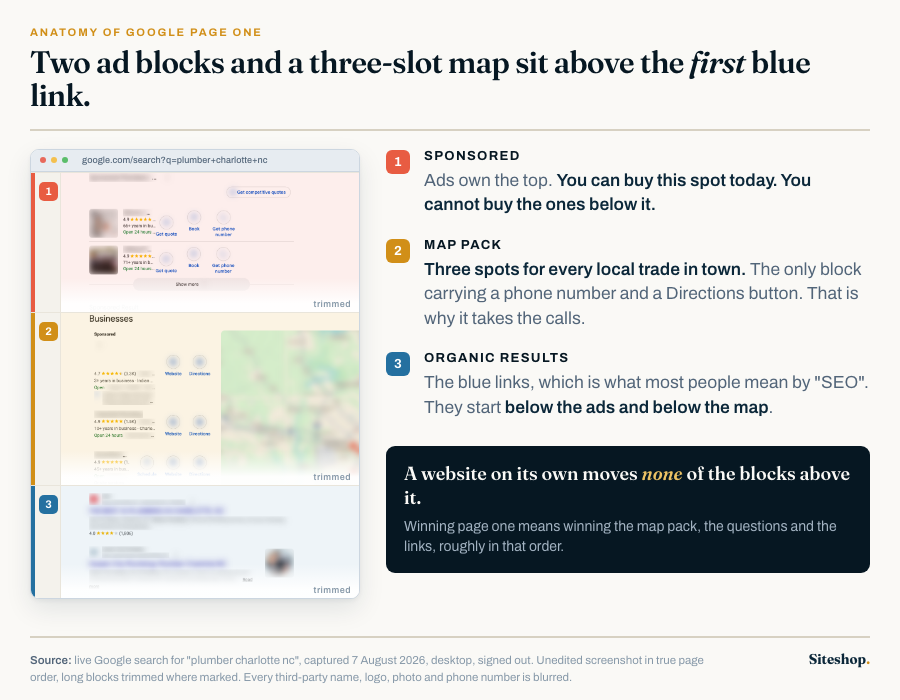
A real page one, captured this month. Ads first, then the three-spot map pack, and the first true blue link most of a screen down. Each block is won differently, and that's the job.
What arrives
What you get: 6 deliverables per page, worked on a monthly cycle.
- 01
Titles rewritten against one query
One page, one primary search, a title that fits inside the roughly 60 characters Google shows. Written to earn a click on a results page, not to hold every keyword you sell.
- 02
One H1, then answer-shaped headings
A single H1, then subheadings that state a result rather than name a topic. This is the structure both Google and an assistant use to decide which chunk of your page answers the question.
- 03
The answer inside the first 40 words
The direct answer moved to the top of the page, in plain words, before any company history. Everything that used to open the page still exists. It just no longer stands in front of the point.
- 04
Internal links pointed at money pages
Links from your supporting pages into the ones that take bookings, using anchor text that says what is on the other end. Most sites we open link everything back to the homepage and nowhere else.
- 05
Overlapping pages resolved
Two of your pages chasing the same search split the signal and neither one wins (keyword cannibalisation). We find the overlap, then either merge them or give each a distinct job.
- 06
Structured data that matches the page
Service, breadcrumb plus FAQ markup written to describe what is actually on the page. Markup that describes something the page does not contain is a manual action waiting to happen.
Fit
Who this fits: 4 signs it is you.
On-page work assumes there is something to work on. Existing pages, some impressions, a site that gets crawled. Given those, it is the fastest cheap win available.
This is you if:
- You get impressions in Search Console and almost no clicks.
- You sit on page two for terms you should already own.
- Your copy was written by whoever built the site, filling boxes.
- You want assistants quoting your page instead of skipping past it.
This is not you if:
- Your site is six pages old with no traffic yet. There is nothing to rewrite, and a build or a foundations program comes first.
- You want the target phrase repeated 30 times. That stopped working over a decade ago and it still reads exactly like what it is.
- You want a report rather than a rewrite. We hand back finished copy, and somebody has to publish it.
- You are shopping for a free on-page checker. Several good ones exist, they cost nothing, and this is the work that starts after one.
How the work runs
How it runs: 4 steps per page, worked on a monthly cycle.
- 01
Pull the query set
What the page already gets impressions for, what it should get them for, plus what the pages currently outranking it answer that yours does not.
- 02
Score what is there
Title, headings, opening, links, markup checked against the query set, so you can see what was wrong before rather than only what changed.
- 03
Rewrite it properly
Finished copy handed back ready to publish, in your voice, with the answer at the top. Not a list of suggestions for somebody else to interpret.
- 04
Publish and watch
Change logged with a date against it, then impressions and position tracked from that date so the page can be judged rather than assumed.
Proof, not a pitch
Built by people who ran the truck first.
Writing ad headlines against a real budget teaches you quickly that the first line either earns the second one or it does not. On-page work is that same discipline applied to a page that has to win the click without paying for it.
- 300+
- Points in the Deep Audit, worked by hand
- 36
- Hyperlocal pages shipped in one build
- 14
- Categories in the Deep Audit, worked by hand
Every point listed in the report appendix
6 service areas × 6 services, same engagement
300+ points, $1,500
Search
What it costs: published, not quoted.
On-page work sits inside the Local Engine at $1,500 a month, with the page count agreed in writing per engagement. The Market Engine at $3,000 a month runs the same work across every market you serve with the page count agreed before you sign, which is the tier to be on if you have a backlog of thin pages across several towns.
Start on the Local Engine. Move up to the Market Engine when you are ready to own more than one town, and to the In-House Engine when you want a marketing department without the hire.
Every retainer tier, with what is in it| Tier | Price | What moves the number |
|---|---|---|
| Local Engine Get found where you already work: the map pack and the searches that ring the phone. | $1,500 per month | The price is flat. What changes is where the effort points: a harder town, or more services, means the same monthly hours aimed at fewer targets, and we say which before you sign. Page counts and posting frequency are agreed in writing per engagement, so scope cannot quietly drift. Not included. Multi-market page coverage, expanded listings and the AI-search program at full strength are the Market Engine. We would rather tell you when you are ready for it than sell it to you early. |
| Market Engine Own every town you serve: coverage pages, AI-search visibility, listings everywhere that counts. | $3,000 per month | How many markets and how many services. The price is flat, and the page program inside it is agreed up front, in writing, so the scope cannot quietly drift. Not included. Placements on other platforms, PR-grade link campaigns, social management, video creative and conversion testing are the In-House Engine, and it is capacity-capped. |
| In-House Engine Everything, run for you: search, content, placements, PR-grade links, social presence, video creative, conversion work, quarterly strategy. | $6,000 per month | Capacity, not scope creep. We run a small number of these engagements at a time so the work stays deep rather than spread thin across too many accounts. Not included. We still do not sell paid ad management, and we still will not commit to a monthly number of editorial links. Both get the same answer at every tier. This tier is also capacity-capped: a few seats, run deep, and we will say plainly if one is not open yet. |
Objections and questions
Questions we get asked: 6 answers.
Six questions, answered short. This page is narrow on purpose and padding it would be the opposite of the point.
Ask us something else How much do on-page SEO services cost?
On-page work is not sold separately here. It is inside the Local Engine at $1,500 a month, which includes pages built or optimised every month, with the count agreed in writing per engagement, alongside the profile work, citations, the review engine, technical upkeep plus a monthly report and a real call. The Market Engine at $3,000 a month runs it across every market you serve, with the page count agreed up front. If you only want a one-off pass across an existing site, that is quoted as audit work instead, and the free Snapshot tells you first whether a pass is worth buying.
What is on-page SEO?
On-page SEO is everything on the page itself that affects whether it ranks and whether anyone clicks: the title tag, the meta description, the H1, the subheadings, the opening paragraph, the body copy, the internal links, the images plus the structured data. Off-page is what happens elsewhere, mainly links and mentions. Technical SEO is whether the page can be crawled and loaded at all. All three matter, and on-page is the one entirely under your control.
Can I just run a free on-page SEO check instead?
You can, and you probably should before you buy anything. A free checker will tell you a title is too long, an H1 is missing, or an image has no alt text, and fixing those costs you an afternoon. What it will not do is rewrite the page so it answers the query better than the four sites above you, because that requires reading those four sites and knowing your trade. The score is the easy half. The rewrite is what you would be paying for.
How many pages can you rewrite each month?
It is agreed in writing before we start, sized to your backlog on the Local Engine and widened on the Market Engine once you are working more than one town. We would rather put a real number in your scope document than a rough target on a marketing page, because an unbounded on-page line is exactly how a retainer turns into unpaid overtime for us or an unmet expectation for you. Pages are worked in priority order: the ones already earning impressions get rewritten first, since those move soonest, and the untouched ones follow.
Does on-page SEO help with AI search and ChatGPT?
Yes, directly, which is the most useful thing about it right now. Assistants pull a passage that answers a question and cite the page it came from. The passage has to be findable: a clear question-shaped heading, a direct answer under it, plain language, no wind-up. Every one of those is on-page work. It is the same rewrite that helps a person scanning on a phone, which is a rare case where two audiences want the identical thing.
How long before a rewritten page moves?
Usually 2 to 8 weeks for a page Google already knows about, because it has to be recrawled and reassessed. A brand-new page takes longer. Some rewrites move a page several positions inside a month, some move nothing and tell you the problem was never on-page. That second outcome is worth knowing early, since it points the budget at links or technical work instead of more copy.
Related services
What this pairs with: the rest of the stack.
Every one of these is sold on its own, and none of them needs the others to work. On-Page SEO sits inside SEO Services, which is where the whole line is laid out side by side.
- 01 SEO Services The half that decides whether anyone sees the site: Google, Maps, plus the AI answers your buyers are already reading. Read more
- 02 Technical SEO Crawl, index, speed, schema. The plumbing under the rankings. Read more
- 03 AI Search Optimization Getting cited in ChatGPT and Perplexity, and in Google's AI Overviews. Almost nobody local sells this. Read more
- 04 Local SEO Ranking in the map pack for the towns you actually serve. Read more
- 05 SEO Audits The hand-built teardown, including keyword and opportunity research. Read more
- 06 Conversion Rate Optimization Find where the traffic you already have quietly leaks away. Read more
Trades
Who we do this for: named by trade.
What a page has to answer changes by trade. Emergency work needs price and availability in the first screen. Project work needs scope, process, plus the part where something goes wrong.
- 01 HVAC Marketing Emergency calls, maintenance plans, and the seasons that pay for the year. Read more
- 02 Plumber Marketing Emergency intent converts in seconds. Most plumbing sites lose it. Read more
- 03 SEO for Roofers Storm-season demand is won in the map pack, not the phone book. Read more
- 04 Remodeling Marketing Long consideration cycles need proof published, not promised. Read more
- 05 Pest Control Marketing The recurring contract is the business. Sites keep burying it. Read more
- 06 Cleaning Company Marketing Residential and commercial are two funnels, not one page. Read more
Free snapshot · paid teardown
Send us your site: 300+ points, worked by hand.
A short, sharp look: the top handful of findings, scored, delivered by email. What's broken, in plain English.
Want the full punch list? The Deep Audit is $1,500: the same crawler and link indexes the top-tier agencies run, plus live map-pack checks town by town and AI-assistant citation checks almost nobody local does. 300+ points across all 14 categories, plus a prioritized 90-day plan. Credited in full toward your first month if you hire us within 60 days.
Snapshot delivered in a few business days
It's yours either way. Hand it to your own developer, or your own AI, and it still pays for itself. If you hire us, it costs you nothing.
Site & search audit · what we check
300+ points
- Crawl, indexation and site security 30 pts
- Duplicate signals, structure and internal links 39 pts
- Speed and Core Web Vitals 28 pts
- The experience on a phone 14 pts
- Money pages: content, depth and freshness 24 pts
- Structured data and the trust surface 20 pts
- Search demand and the keyword map 20 pts
- Google Business Profile 20 pts
- Reviews and reputation 16 pts
- Local presence: map results and directories 20 pts
- AI search and assistant citation 22 pts
- Link profile and authority 20 pts
- The operators beating you 22 pts
- Turning visits into calls, and counting them 24 pts
The Snapshot is the top handful of these, free. The Deep Audit is all 14 categories, 300+ points, scored, with a 90-day plan and the full point-by-point appendix. No account, no card either way.
Ready to stop losing customers to the guy with a better site?
Fifteen minutes, no discovery deck. We'll tell you what we'd build, what we'd rank, and what it costs. And if we're not the right fit, we'll say that too.