Search · Technical SEO
The plumbing under the rankings.
Three gates sit between your page and a ranking: can Google reach it, does Google keep it, does it load fast enough to count. Good content stuck behind any one of them ranks nowhere.

The short answer
What technical SEO services actually are: making the site readable to a machine first.
Technical SEO is the work that lets Google reach your pages (crawling), keep them in its results (indexing), and load them fast enough on a phone to count. It is unglamorous plumbing, and it is the reason plenty of genuinely good content never ranks at all.
Reaching the page is gate one. Google's software follows links to find pages. A page nothing links to, or one blocked by a stray line in a single settings file (robots.txt), is invisible no matter how well it is written.
Keeping the page is gate two. Reaching is not keeping. Google drops what it judges to be a duplicate of something it already stored, which is quietly what happens to twelve service-area pages that differ only by the town name in the heading.
Loading is gate three. Google measures how fast your main content appears and how quickly the page reacts to a tap (Core Web Vitals). The published bars are 2.5 seconds and 200 milliseconds, measured on mobile, because a phone on a job site is the real device.
The honest limit: this work removes obstacles, it does not create demand. A clean fast site with nothing worth ranking for still will not rank. We check the demand side first so we are not selling you plumbing for a building nobody wants to enter.
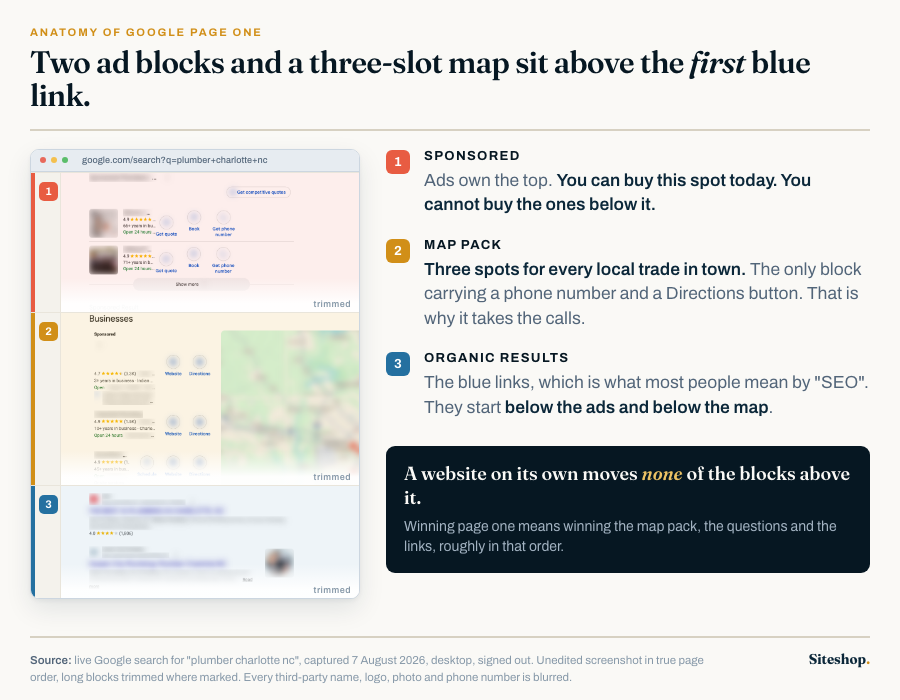
A real page one, captured this month. Ads first, then the three-spot map pack, and the first true blue link most of a screen down. Each block is won differently, and that's the job.
What arrives
What you get: 6 deliverables, every one of them checkable.
- 01
A full crawl of the site
We walk your site the way Google's software does and produce the real list: pages it can reach, pages it cannot, pages it only reaches through a chain of forwards (redirects). Orphan pages nobody ever linked to usually surface here first.
- 02
Index coverage checked page by page
Being in Google's results is a yes or no per page, so we check it per page instead of assuming. Any page you care about that is missing gets a reason written next to it: duplicate, blocked, or too thin to keep.
- 03
Speed measured on a phone
Loading measured the way Google measures it, on mobile, against the 2.5 second and 200 millisecond bars. Oversized images, font loading plus whatever tracking scripts got bolted on over the years are the usual culprits.
- 04
Structured data added and validated
A label in the page code telling Google what the thing is (structured data): a local business, a service, a review, a set of questions. Added, then run through Google's own testing tool so we know it parsed.
- 05
A redirect map for anything moved
Every old address pointed at its new home, one to one, so rankings survive the move. Skipping this is the single most common way a redesign quietly costs an operator a year of traffic nobody can trace back.
- 06
A fix list ranked by what it costs you
Findings sorted by impact against effort rather than by severity rating. Usually 3 things matter and 40 do not, and a report that will not tell you which is which is just a longer invoice with a chart on it.
Fit
Who this fits: 4 signs the plumbing is the problem.
Technical work pays when the content exists and still does not perform. If a page is written, published, and invisible, this is where the answer lives rather than in another round of rewriting.
This is you if:
- You publish pages that never show up in Google, even weeks later.
- The site was redesigned in the last two years and traffic never came back.
- Pages load fine on your laptop and crawl on a phone with two bars.
- You have more pages than you can name, left behind by an old build or a plugin.
This is not you if:
- You have 8 pages, all indexed, loading in under two seconds. There is nothing here worth selling you.
- You want a technical audit instead of content. Clean pipes carrying nothing still deliver nothing.
- You need the phone ringing this week. Fixing crawl problems is a compounding asset, not a campaign.
- Nobody on your side can deploy a change and there is no budget for us to. A fix list nobody applies is wallpaper.
How the work runs
How it runs: 4 steps, then a monthly crawl.
- 01
Crawl the baseline
We crawl every reachable page and record the state before anything is touched, so each later claim has a dated before behind it rather than a memory.
- 02
Check the index
Page by page against Google's own coverage data, because a page can be crawled perfectly and still be missing from the results for a reason worth knowing.
- 03
Fix in impact order
The 3 issues costing you rankings first, the 40 cosmetic ones later or never. Each fix gets re-tested on the live page rather than marked done in a tracker.
- 04
Re-crawl monthly
Sites break quietly. A plugin update, a new page template, one changed setting. The technical upkeep inside the retainer is what catches it in weeks instead of quarters.
Proof, not a pitch
Built by people who ran the truck first.
Two service businesses run out of the back of a truck taught us what an invisible page costs. Nothing looks broken, the site is up, the phone simply stops. Technical work is where that gets found and dated.
- 300+
- Points in the Deep Audit, worked by hand
- 36
- Hyperlocal pages shipped in one build
- 14
- Categories in the Deep Audit, worked by hand
Every point listed in the report appendix
6 service areas × 6 services, same engagement
300+ points, $1,500
Search
What it costs: published, not quoted.
Technical upkeep sits inside the Local Engine at $1,500 a month, and the Market Engine at $3,000 a month runs it across every market you serve. A one-off teardown is quoted as audit work rather than as a retainer line, and what moves either number is page count plus whether the site is hand-built or fifteen plugins deep.
Start on the Local Engine. Move up to the Market Engine when you are ready to own more than one town, and to the In-House Engine when you want a marketing department without the hire.
Every retainer tier, with what is in it| Tier | Price | What moves the number |
|---|---|---|
| Local Engine Get found where you already work: the map pack and the searches that ring the phone. | $1,500 per month | The price is flat. What changes is where the effort points: a harder town, or more services, means the same monthly hours aimed at fewer targets, and we say which before you sign. Page counts and posting frequency are agreed in writing per engagement, so scope cannot quietly drift. Not included. Multi-market page coverage, expanded listings and the AI-search program at full strength are the Market Engine. We would rather tell you when you are ready for it than sell it to you early. |
| Market Engine Own every town you serve: coverage pages, AI-search visibility, listings everywhere that counts. | $3,000 per month | How many markets and how many services. The price is flat, and the page program inside it is agreed up front, in writing, so the scope cannot quietly drift. Not included. Placements on other platforms, PR-grade link campaigns, social management, video creative and conversion testing are the In-House Engine, and it is capacity-capped. |
| In-House Engine Everything, run for you: search, content, placements, PR-grade links, social presence, video creative, conversion work, quarterly strategy. | $6,000 per month | Capacity, not scope creep. We run a small number of these engagements at a time so the work stays deep rather than spread thin across too many accounts. Not included. We still do not sell paid ad management, and we still will not commit to a monthly number of editorial links. Both get the same answer at every tier. This tier is also capacity-capped: a few seats, run deep, and we will say plainly if one is not open yet. |
Objections and questions
Questions we get asked: 6 answers.
Buyers usually arrive at this page after a rebuild went wrong or a page refused to appear. These are the six questions that follow.
Ask us something else How much does technical SEO cost?
Ongoing technical upkeep is inside the Local Engine at $1,500 a month, which also carries pages built or optimised every month, the profile worked every week and the review engine, all agreed in writing per engagement. The Market Engine at $3,000 a month runs the same upkeep across every market you serve. A one-off teardown is priced as Deep Audit work against the size of the site: $1,500, credited to month one if you hire us within 60 days, back in a few business days, which is enough to tell you whether the technical side is your actual problem.
Why isn't my page showing up on Google?
There are four common reasons and they are checkable in order. Nothing links to the page so Google never found it. A setting blocks it, either in the site's robots file or in a tag on the page itself. Google found it, decided it duplicates a page it already has, and kept only one. Or the page is genuinely too thin to be worth storing. Each of those has a different fix, and guessing between them is how a month gets spent rewriting copy that was never the problem.
Does site speed really affect rankings?
It affects rankings, and it affects revenue more. Google uses loading measurements as a ranking input and publishes the bars: main content visible within 2.5 seconds, a response to a tap within 200 milliseconds. Speed is rarely the single reason a page does not rank. It is very often the reason a page that ranks does not convert, because a customer standing in a driveway with one bar of signal does not wait. We measure on mobile for that reason, never on a desktop connection.
What is schema markup and do I need it?
Schema is a label written into the page code telling Google what the thing on the page actually is: a local business, a service, a review, a frequently asked question. It does not make you rank higher on its own. What it does is make you eligible for the richer results that take up more space on the page, and it makes your content easier for AI answer engines to lift and cite correctly. For a local service business the local business and service labels are the two that matter.
Can technical SEO fix a redesign that killed my traffic?
Usually a lot of it, and the sooner the better. The typical cause is simple: the new site shipped with new addresses for every page, the old ones now lead nowhere, and every ranking Google had built against them was pointed at a dead end. The fix is a redirect map, one old address to one new address, plus a crawl to catch what got missed. Recovery is rarely total if a year has passed, and we will tell you what looks recoverable before you spend anything.
Do I need technical SEO if my site is only a year old?
Often no, and this answer costs us work. A recently built site on a decent platform usually clears all three gates already, and paying for a technical program on top of that is buying a solved problem. The exceptions are worth checking: a site moved from another platform, a site with more pages than the owner can name, or a site where new pages take weeks to appear in Google. The free audit will tell you which one you are in without a sales call attached.
Related services
What this pairs with: the rest of the stack.
Every one of these is sold on its own, and none of them needs the others to work. Technical SEO sits inside SEO Services, which is where the whole line is laid out side by side.
- 01 SEO Services The half that decides whether anyone sees the site: Google, Maps, plus the AI answers your buyers are already reading. Read more
- 02 On-Page SEO Titles, structure, copy. All of it answering the query outright. Read more
- 03 SEO Audits The hand-built teardown, including keyword and opportunity research. Read more
- 04 Local SEO Ranking in the map pack for the towns you actually serve. Read more
- 05 AI Search Optimization Getting cited in ChatGPT and Perplexity, and in Google's AI Overviews. Almost nobody local sells this. Read more
- 06 Website Redesign Rebuilt on modern architecture without losing what already ranks. Read more
Trades
Who we do this for: named by trade.
The technical failure mode differs by trade. Multi-location contractors bury pages in an unreachable structure, while single-truck operators more often carry one slow page template across every service they sell.
- 01 Contractor Website Design A site that reads like a firm homeowners trust with a six-figure job. Read more
- 02 SEO for Roofers Storm-season demand is won in the map pack, not the phone book. Read more
- 03 HVAC Marketing Emergency calls, maintenance plans, and the seasons that pay for the year. Read more
- 04 Plumber Marketing Emergency intent converts in seconds. Most plumbing sites lose it. Read more
- 05 Remodeling Marketing Long consideration cycles need proof published, not promised. Read more
- 06 Pest Control Marketing The recurring contract is the business. Sites keep burying it. Read more
Free snapshot · paid teardown
Send us your site: 300+ points, worked by hand.
A short, sharp look: the top handful of findings, scored, delivered by email. What's broken, in plain English.
Want the full punch list? The Deep Audit is $1,500: the same crawler and link indexes the top-tier agencies run, plus live map-pack checks town by town and AI-assistant citation checks almost nobody local does. 300+ points across all 14 categories, plus a prioritized 90-day plan. Credited in full toward your first month if you hire us within 60 days.
Snapshot delivered in a few business days
It's yours either way. Hand it to your own developer, or your own AI, and it still pays for itself. If you hire us, it costs you nothing.
Site & search audit · what we check
300+ points
- Crawl, indexation and site security 30 pts
- Duplicate signals, structure and internal links 39 pts
- Speed and Core Web Vitals 28 pts
- The experience on a phone 14 pts
- Money pages: content, depth and freshness 24 pts
- Structured data and the trust surface 20 pts
- Search demand and the keyword map 20 pts
- Google Business Profile 20 pts
- Reviews and reputation 16 pts
- Local presence: map results and directories 20 pts
- AI search and assistant citation 22 pts
- Link profile and authority 20 pts
- The operators beating you 22 pts
- Turning visits into calls, and counting them 24 pts
The Snapshot is the top handful of these, free. The Deep Audit is all 14 categories, 300+ points, scored, with a 90-day plan and the full point-by-point appendix. No account, no card either way.
Ready to stop losing customers to the guy with a better site?
Fifteen minutes, no discovery deck. We'll tell you what we'd build, what we'd rank, and what it costs. And if we're not the right fit, we'll say that too.