Industries · General contracting
Contractor web design: a site that reads like a firm worth six figures.
General contracting still runs on referrals. The referral just does not close itself anymore. It gets checked against your website first, alone, on a phone, before anybody dials your number.
The short answer
What we actually fix first: the page where a referral gets confirmed or quietly dropped.
A general contractor's site is not a lead magnet. It is a verification step. Somebody already has your name, so the site decides whether they call. Published work, a published process, published price ranges, plus licensing and insurance visible without hunting for them.
Referral traffic converts better than anything you could buy, and most contractors waste it. The name gets passed at a dinner table. The decision gets made alone, on a phone, against whatever your site happens to show that evening.
Published work is the whole argument. Not stock photos of somebody else's kitchen: your jobs, shot on your sites, with the scope written underneath. A dozen real projects beat a page of adjectives about craftsmanship every time.
Price ranges are the fight we have most often. Contractors hate publishing them. A homeowner who finds no number anywhere assumes the worst and calls the firm that gave them one, which is how a good builder loses a job it never knew existed.
One limit worth stating up front: this work argues for a conversion asset first and a search asset second. If your problem is a thin pipeline rather than a leaky one, say so on the call and we will weight the search side heavier instead.
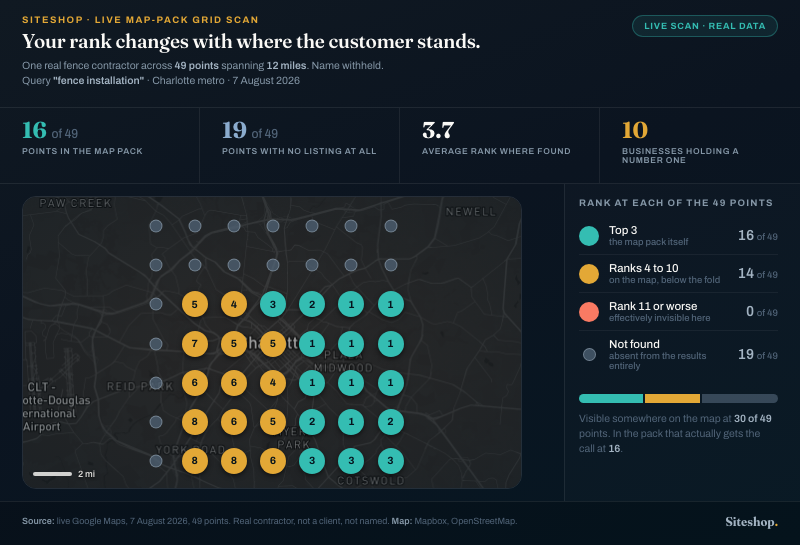
A real scan: 49 checkpoints, one live map lookup each. Green means the map pack, grey means invisible at that spot. This is how we measure the work, spot by spot, not by searching from the office chair.
Real query shapes
What your buyers actually ask: 6 ways the decision gets made.
Contractor demand arrives partly through search and partly through a referral checking you out. Both routes end on your site, and they are looking for different things when they get there.
-
"Who's a good general contractor around here?"
The main local search. Wants a page for the town they live in, with jobs from that town on it, not a list of towns in a footer.
-
"Someone at dinner mentioned your name, let me check you out."
The referral check. The highest-intent visit you will ever receive, and the only one where you have already won and can still lose it.
-
"We're thinking about a home addition."
Service-specific and high ticket. This buyer knows what they want built and is looking for someone who has built it before.
-
"What would an addition even cost?"
Question intent, months ahead of the job. A real range with the variables named puts you on the shortlist before anybody is contacted.
-
"Are they actually licensed?"
Trust filter, asked quietly. License number, bond, and carrier visible on the site, plus a complete Google profile, answer it before it is asked out loud.
-
"We manage a few properties and need someone reliable."
A different buyer entirely. Property managers want references, schedule reliability, and insurance limits, and usually earn their own section.
These are not verbatim quotes from a call log. They are the shapes a referral and a cold search actually take, in plain language, because a homeowner does not think in search terms and neither should the page built for them.
What arrives
What we build for a general contractor: 6 pieces that do the closing.
- 01
A project library, not a gallery
Each job gets a page: scope, materials, timeline, plus before and after photos. A search finds these pages and a referral reads them. A grid of unlabeled photos does neither job.
- 02
Price ranges by job type
Kitchens, additions, whole-home renovations. A range with the variables named underneath, so a homeowner can work out whether they can afford you instead of going quiet after the quote request.
- 03
Licensing and insurance in the open
Your license number plus your insurance carrier stated on the site rather than promised on request. Commercial buyers filter on this before reading anything else, and homeowners on a six-figure job check it too.
- 04
A process page that reads like a process
What happens between the first call and the final walkthrough, stages named, payment schedule explained. It answers the question every homeowner is too polite to ask, which is what they are actually buying.
- 05
Town pages tied to real jobs
One page per town you build in, each linking to the projects you completed there. 36 hyperlocal pages inside a single build is a shape we have shipped before: 6 towns across 6 services.
- 06
A quote request that qualifies
Budget range, timeline, scope captured in the form, so the calls you take come from people who can afford the job. Fewer requests, better ones, and we will say that out loud rather than sell you volume.
Fit
Who this fits: 4 signs it is you.
General contracting is the trade where the website does the least prospecting and the most closing. The referrals you already receive and lose without ever hearing about it are usually the bigger number.
This is you if:
- Most of your work arrives by referral, and you suspect some of it leaks before the call happens.
- You have finished projects worth publishing plus photos nobody has ever organized.
- You are comfortable publishing price ranges, or you are willing to be argued into it.
- You want fewer, better-qualified quote requests rather than a bigger pile of them.
We will tell you no if:
- You will not publish a price range of any kind. The site can still be built, but half of what makes it work is off the table, and we would rather you knew that first.
- You have no photos of your own work and no plan to get any. A contractor site without real projects is a brochure with a phone number on it.
- You need jobs booked this month. A build takes a build's time, and the search work compounds after it.
- You are looking for a guaranteed lead count. Nobody can sell you one honestly, and we will not pretend otherwise.
How the work runs
What changes, month by month: the first 90 days.
- 01
Weeks 1 to 2: the free audit and the project pull
The 14-category audit, worked by hand across your current site and your Google profile. Then we go through your finished projects, pick the ones that sell the jobs you want more of, and write the scope for each. Clients underestimate how much this step matters, every time.
- 02
Weeks 3 to 8: the site gets built
Starter at $1,500 or Growth at $2,500, depending on how many services and towns need pages of their own. You own the domain, the code, and the content from day one.
- 03
Month 2 and on: referral leakage narrows
Once the site is live, most contractors notice the change first in the referral traffic: fewer people who had your name but never called. That shift usually shows up before any search work even starts.
- 04
Month 3 and beyond: search compounds on top
The Local Engine runs $1,500 a month once you are ready to bring in cold search demand, not just close referrals. Map-pack position and page rankings get tracked, so you are watching movement rather than waiting on a promise.
Proof, not a pitch
Built by people who ran the truck first.
This program is built by an operator who ran a multi-state service business himself, not a marketing team improvising with a trade he has never worked. Their public work is on the case-studies page: a full build with published prices and a proof library, the same project-proof approach this page argues for.
- 300+
- Points in the Deep Audit, worked by hand
- 36
- Hyperlocal pages shipped in one build
- 14
- Categories in the Deep Audit, worked by hand
Every point listed in the report appendix
6 service areas × 6 services, same engagement
300+ points, $1,500
Build
What it costs: published, not quoted.
This trade prices against the build ladder first: Starter at $1,500, Growth at $2,500, custom from $3,000 one-time. What moves the number is how many services get pages of their own, plus whether the project library needs writing from scratch or already exists in a folder somewhere.
Every build price, on one page| Tier | Price | What moves the number |
|---|---|---|
| Starter site The core site a local operator actually needs: services, service area, proof, plus a phone number that is never more than a thumb away. | $1,500 one-time | Page count, and how much of the content we write for you. Not included. Per-city page sets and published pricing pages are the Growth site. Ongoing search work is a separate monthly engagement. |
| Growth site The Starter site plus the pages that earn search traffic on their own: per-service and per-city pages, published pricing, and the proof library. | $2,500 one-time | How many service areas you need covered, and how many services get their own page. Not included. Custom application work sits in the Custom tier. Moving off an old site that already ranks? Rank-safe migration attaches to any build as a $400 line item. |
| Custom builds Larger builds and custom work, plus migrations where an existing site has rankings that have to survive the move. | from $3,000 one-time | Whether there are rankings to carry across, and how much of the build is bespoke rather than assembled. Not included. Rank-safe migration off an existing site attaches as a $400 line item where there are rankings to carry across. |
Objections and questions
Questions we get asked: 6 answers.
These are the questions general contractors actually ask on a first call, including the two we answer against our own interest.
Ask us something else How much does this cost?
Builds are one-time: $1,500 for the Starter site, $2,500 for the Growth site with a service and town page set plus published pricing, from $3,000 for custom work or a migration where existing rankings have to survive the move. Upkeep after that is $99 a month for hosting managed, updates, backups, plus a couple of small content edits a month. Ongoing search work is separate and starts at $1,500 a month once you want the site working on cold demand, not just referrals.
Should a contractor publish prices on the website?
Ranges, yes. Exact quotes, no, and nobody is asking you for one. A homeowner searching what an addition costs is trying to find out whether the project is possible at all, and a site that gives them a range with the variables named earns the call from the firms that stayed silent. The fear is that you get talked down on price. What actually happens is that you stop spending evenings quoting jobs for people who were never in your bracket.
Do I need ongoing marketing if all my work comes from referrals?
Maybe not, and we would rather say that than sell you a retainer. If you are booked out twelve months and happy with the mix of work, build the site so the referrals stop leaking and leave it there. Ongoing work earns its keep when you want to choose your jobs instead of taking what arrives, or when you want work in a town where nobody knows your name yet. Start with the build. Add the rest when the reason for it is real.
How many project pages do I actually need?
Fewer than you think, chosen better than most. A dozen projects that map to the work you want more of will outperform sixty that show everything you have ever touched. Each one needs the scope written, the materials named, the timeline stated, plus photos from the actual site.
Who owns the website when it is finished?
You do, completely. Domain, code, content, analytics: all of it lives in your accounts rather than ours, from day one. If you ever stop working with us, the site keeps running and you keep the keys.
How long until the phone rings differently?
Most contractors notice the referral change first, usually inside a month or two of the new site going live, because that is demand that already existed and was leaking before. Cold search takes longer to move: town and service pages typically need a few months to earn their place, and we would rather say that plainly than promise a date.
Services
What we would actually run: the pieces that fit this trade.
For a general contractor the build carries most of the weight, so the web-design work leads. The search side follows once the site is worth sending traffic to, which is the order that stops you paying to send buyers at a page that loses them.
- 01 Website Redesign Rebuilt on modern architecture without losing what already ranks. Read more
- 02 Conversion Rate Optimization Find where the traffic you already have quietly leaks away. Read more
- 03 Website Maintenance Updates, backups, speed fixes, plus the small edits you never get to. Read more
- 04 Local SEO Ranking in the map pack for the towns you actually serve. Read more
- 05 On-Page SEO Titles, structure, copy. All of it answering the query outright. Read more
- 06 Google Business Profile Management The profile worked weekly, not claimed once and forgotten. Read more
Other trades
6 more trades we work in: each one named for its own search.
Every trade below is a separate page, because every trade gets searched differently. If yours is not listed anywhere on the site, ask, because the list is shorter than the work.
- 01 HVAC Marketing Emergency calls, maintenance plans, and the seasons that pay for the year. Read more
- 02 Plumber Marketing Emergency intent converts in seconds. Most plumbing sites lose it. Read more
- 03 Remodeling Marketing Long consideration cycles need proof published, not promised. Read more
- 04 Marketing for Electricians Panel upgrades and EV chargers are the pages almost nobody has built. Read more
- 05 Pest Control Marketing The recurring contract is the business. Sites keep burying it. Read more
- 06 Painting Contractor Websites Portfolio-led, priced honestly, bookable from a phone. Read more
Free snapshot · paid teardown
Send us your site: 300+ points, worked by hand.
A short, sharp look: the top handful of findings, scored, delivered by email. What's broken, in plain English.
Want the full punch list? The Deep Audit is $1,500: the same crawler and link indexes the top-tier agencies run, plus live map-pack checks town by town and AI-assistant citation checks almost nobody local does. 300+ points across all 14 categories, plus a prioritized 90-day plan. Credited in full toward your first month if you hire us within 60 days.
Snapshot delivered in a few business days
It's yours either way. Hand it to your own developer, or your own AI, and it still pays for itself. If you hire us, it costs you nothing.
Site & search audit · what we check
300+ points
- Crawl, indexation and site security 30 pts
- Duplicate signals, structure and internal links 39 pts
- Speed and Core Web Vitals 28 pts
- The experience on a phone 14 pts
- Money pages: content, depth and freshness 24 pts
- Structured data and the trust surface 20 pts
- Search demand and the keyword map 20 pts
- Google Business Profile 20 pts
- Reviews and reputation 16 pts
- Local presence: map results and directories 20 pts
- AI search and assistant citation 22 pts
- Link profile and authority 20 pts
- The operators beating you 22 pts
- Turning visits into calls, and counting them 24 pts
The Snapshot is the top handful of these, free. The Deep Audit is all 14 categories, 300+ points, scored, with a 90-day plan and the full point-by-point appendix. No account, no card either way.
Ready to stop losing customers to the guy with a better site?
Fifteen minutes, no discovery deck. We'll tell you what we'd build, what we'd rank, and what it costs. And if we're not the right fit, we'll say that too.