Industries · HVAC
HVAC marketing: emergency calls, plans, and the seasons that pay.
If we ran an HVAC company in your town, we would start in the shoulder season, and the first thing we would look at is the category printed on your Google profile. Search air conditioning repair in your own town and the top three will nearly all read Air Conditioning Contractor or HVAC Contractor. If yours reads Contractor, or Heating Contractor on its own, half your year is being handed to somebody else and the correction takes about two minutes. Everything after that takes months, which is why the order matters more in this trade than in any other.
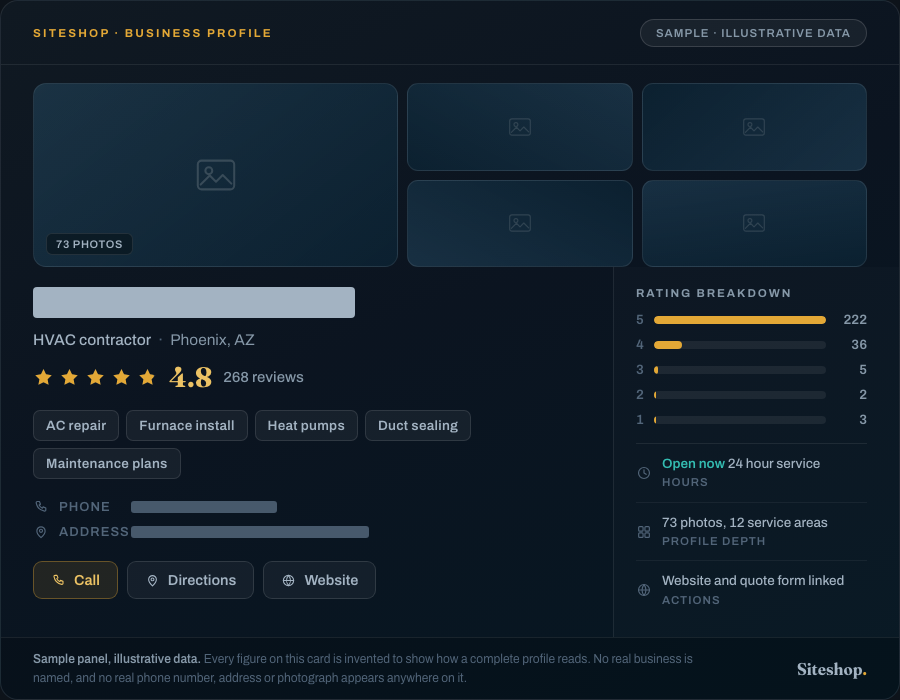
The short answer
The order we would run it in: 3 buyers, 2 seasons, 1 rule that decides the rest.
HVAC serves three buyers who behave nothing alike. The emergency call converts in minutes. The maintenance plan carries the months when nobody calls. The replacement gets researched for weeks and pays like a small remodel. One page cannot route all three, and most HVAC sites only ever built the first one.
Emergency intent is a speed problem. Hold a map pack spot, load fast on a phone in a cold house, and put a tappable number where a thumb already rests. Whoever picks up first usually wins, so the site's job is to be the first number seen rather than the most impressive one read.
Maintenance plans sell on economics. What the plan costs a month, how many visits it carries, what priority scheduling actually means in February, and what a failed compressor costs instead. That is a page with numbers on it. A sentence in a services list is why almost nobody asks.
Replacement is the slowest of the three and the highest ticket. Somebody deciding between another repair and a new system wants efficiency in plain language, financing laid out, and a straight answer about when repairs stop making sense. This is also the buyer most likely to ask an assistant before they ask a contractor, which is why the answer has to exist somewhere an assistant can read it.
Here is the rule that decides more HVAC outcomes than any tactic on this page. Pages started in season are pages that miss it. New pages need months to compound, so anything that has to rank in January gets written in August. Profile work and conversion fixes are the exception, because they act on demand already searching today.
Which leads to the part nobody enjoys hearing. Work started the week the weather turns is late. If you come to us in October wanting this winter, we will tell you what you are actually buying, which is next winter, and let you decide whether that is worth it.
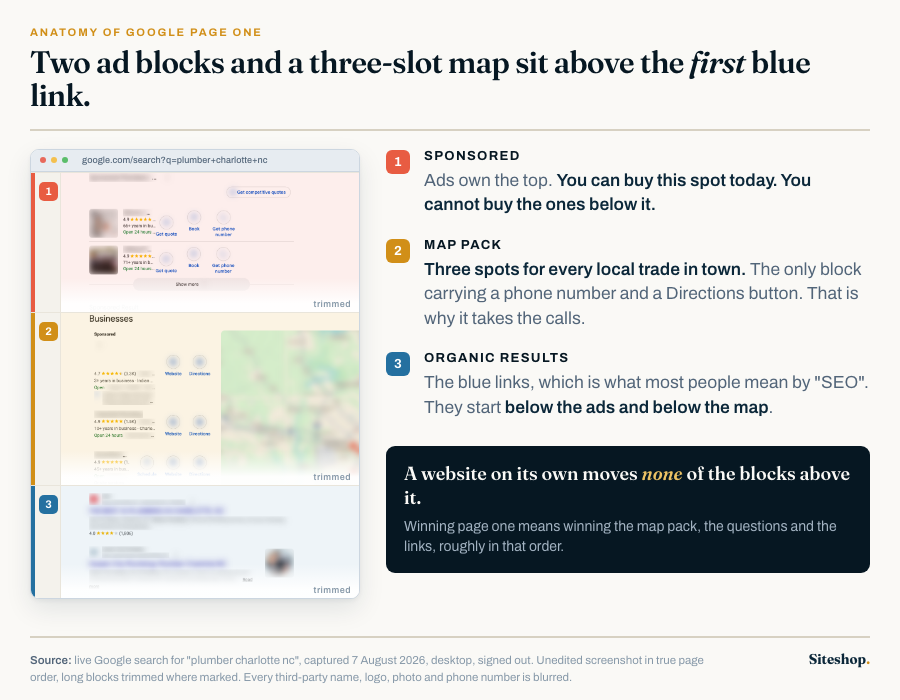
A real page one, captured this month. Ads first, then the three-spot map pack, and the first true blue link most of a screen down. Each block is won differently, and that's the job.
Check it yourself
4 checks that take about 15 minutes and cost nothing.
Two searches, one report you already have access to, and a count on your own website. No form, no email, and nothing here needs us.
- 1
In a private window, search air conditioning repair plus your town. Then search furnace repair plus your town.
Two searches, and in a lot of markets two different top threes. Holding one and not the other means half your year is going to somebody else, and you have just found which half.
- 2
Write down the category printed under each business in both top threes.
That line is the category the owner chose, and it is public. Put it next to yours. A category that does not match the words a homeowner types keeps you out of that search no matter how good the reviews are, and correcting it is the cheapest work in local search.
- 3
Open Search Console, go to Performance, set the range to the last 16 months, and put your January next to your July.
You are looking for which kind of trough you have. Impressions falling while your average position holds is demand leaving for the season, which is the trade. Impressions and position sliding together is a visibility problem, and visibility is the part anybody can do something about.
- 4
Count how many pages on your own site carry a price for the maintenance plan.
For a lot of HVAC sites the count is zero and the plan gets one sentence. A homeowner will not call to ask what it costs. They assume it is expensive and close the tab, and the plan program that was supposed to carry your February never fills.
Nothing on that list needs us, and the right order is to run it first, ahead of any conversation with any agency including this one. If step 1 comes back with your name in both top threes, your search work is in better shape than you think, and we would rather tell you that than sell you a retainer you do not need yet.
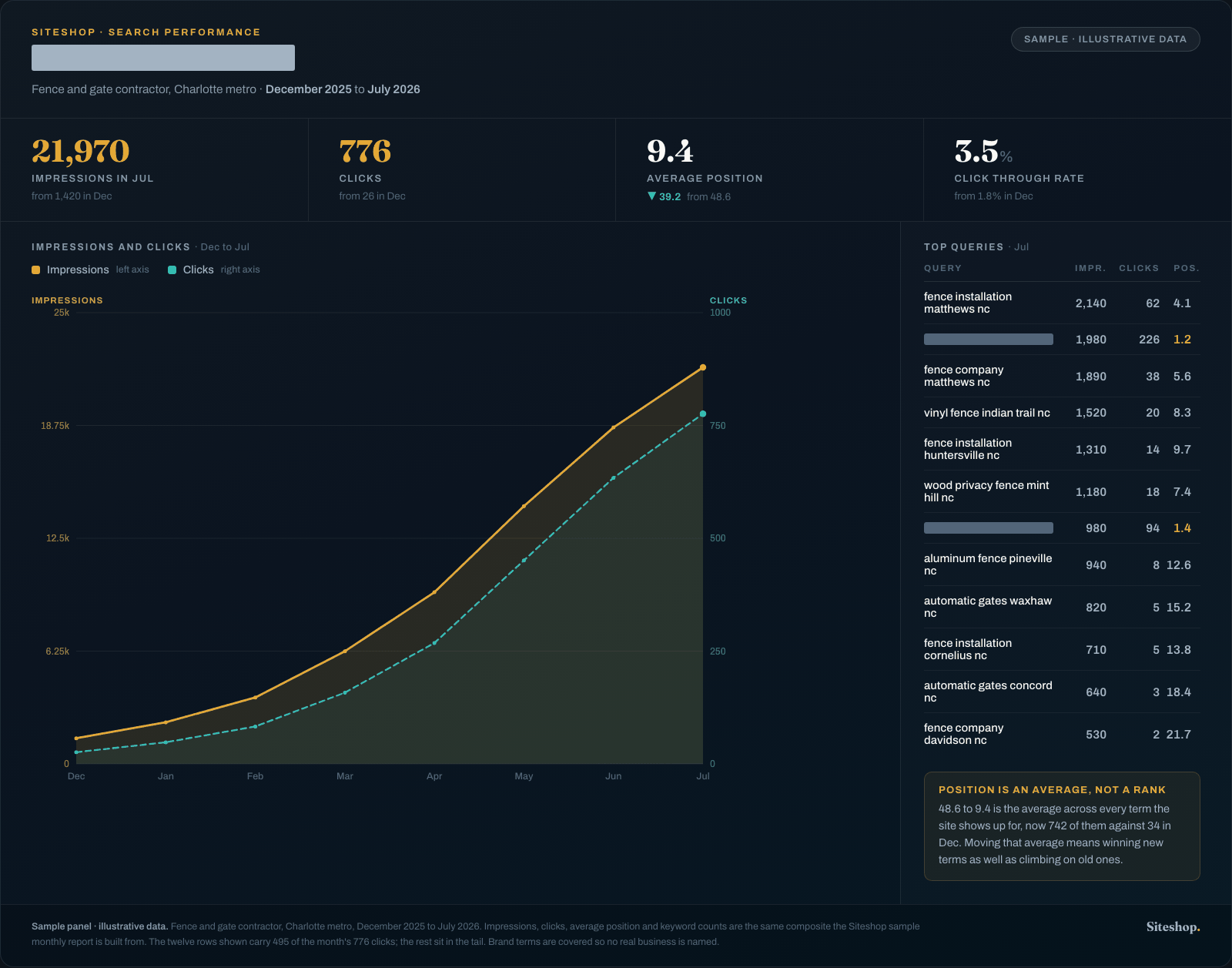
The report from step 3, in our own panel rather than in Google's interface. Two things to read on it. The curve is impressions against clicks, month by month, which is the shape step 3 asks you to find. The note in the bottom corner is the one owners get wrong most often: average position is an average across every term the site shows up for, so it can slide while your best searches climb, purely because you started appearing for hundreds of new ones. Sample panel, illustrative data, composite subject in a different trade.
Real query shapes
What your buyers actually say: 6 ways the call starts.
HVAC demand peaks at opposite ends of the calendar and arrives in shapes that want different pages. Each one has to be built and visible before the weather turns, not while it is turning.
-
"The AC's dead and it's 95 degrees."
Converts in minutes, in July, on a phone. The map pack plus a tappable number decide it before the website finishes loading.
-
"The furnace won't kick on."
The winter base. Wants a real page for their town, because proximity decides who shows up in the pack.
-
"What does a maintenance plan actually cover?"
Plan intent. Publish what it covers and what it costs, and the plan starts selling itself through the off-season.
-
"How much would a whole new system run us?"
The replacement buyer, months out. A published range with the variables named puts you on the shortlist early.
-
"Should we get a heat pump or stick with the furnace?"
Comparison intent with no company name attached. Answer it properly and you hold the buyer through the whole decision.
-
"Who's close and can come today?"
Pure map pack. Review count, category accuracy, and proximity settle it before anybody clicks through to a site.
HVAC demand peaks at opposite ends of the calendar, and these six shapes show the split. Each one wants a different page, built before the weather turns, not while it is turning.
What arrives
6 pieces, built in season order rather than in order of appeal.
- 01
The profile, corrected in the first two weeks
Categories, service area, seasonal services, photos, questions, posts on a set schedule. This goes first because it is the only piece that acts on demand searching today, and during a heat wave it takes calls the website never sees.
- 02
Two routes off the homepage, before any new page gets written
One path for the emergency call and one for the planned job. A number that never leaves the screen on the first, a cost page and a plan page waiting at the end of the second. Splitting the routes changes what every existing visitor is worth, so it happens before the slower work starts.
- 03
Review asks starting in month one
A request that goes out while the tech is still packing up, and replies drafted for you. This is a slow number by nature, and there is no version of it that gets caught up in month six, so month one is the only sensible place to start.
- 04
The maintenance plan page, written in the shoulder season
What it costs, what it covers, how many visits, what happens when a part fails under it, and the comparison against paying for a failure out of pocket. Then it gets linked from every repair page, because the moment somebody just paid for a repair is the moment a plan makes obvious sense.
- 05
Replacement and financing pages, next
Cost ranges by system type, efficiency explained the way a homeowner would explain it, financing spelled out. The highest ticket in the trade and the longest to compound, which is why it goes in early even though it pays late.
- 06
Town pages, published while it is quiet
One page for each town you run trucks to, written and live months before the first cold snap. These come last in the writing order and they need the most patience, because a page that started in season is a page that missed it.
Fit
Who this fits: 4 signs it is you.
HVAC is a trade where a single hot week can decide the month. This work pays back when there is a business behind it that can hold a peak week without falling over.
This is you if:
- You run emergency service, maintenance plans, or replacement work. Ideally all three.
- You have a plan program you want more homeowners on, or you want to start one properly.
- You are planning for next season rather than reacting to the one already underway.
- You'll ask every customer for a review. Say no to that and we would be selling you a plan with a bottleneck built into it, so we would rather not take the job.
We will tell you no if:
- You are mid slow-season and you need calls this week. Buy ads for that. Nothing in this program rescues a season that is already underway.
- Nobody answers the phone after hours during peak. Sending more calls to a business that does not pick up moves the problem rather than fixing it.
- You want a guaranteed map-pack spot. Nobody sells positions, and we will not act as though we do.
- Your summer runs at capacity and your shoulder season is genuinely flat and full too. If nothing about your year is uneven, you may not need this yet.
How the work runs
What changes, month by month: the first 90 days.
- 01
Weeks 1 to 2: the profile and the two routes
Categories and services corrected, the emergency path split from the planned path, the tappable number put on every page, review asks switched on. All of it acts on demand already in the market.
- 02
Weeks 3 to 8: the seasonal pages get written
The plan page, the replacement cost page, then the town pages, all published in the quiet stretch so they have months to compound before the weather does the selling.
- 03
Month 2: near-me demand moves first
Profile fixes and the tappable number act on searches happening today, so most trades see the near-me shape move somewhere in the first couple of months.
- 04
Ahead of peak: the seasonal pages start earning rank
Town and plan pages typically need three to six months to compound, with map position tracked on a grid so you watch the radius move ahead of peak rather than hearing about it after. Anybody putting a metro-wide promise on a 90-day calendar is selling something.
Not worth your money
5 things we would tell an HVAC company to skip.
One of these turns down our own revenue and one is a service sitting in our top tier. Neither belongs in a proposal aimed at an HVAC company.
-
Starting this work in October, for this winter
Profile and conversion fixes can move inside 30 to 60 days. New pages cannot. Starting in October buys you next winter. That is still worth buying. It is not what you were hoping to buy, and we would rather turn the month down than let you find that out in January.
-
Blog posts about the signs your furnace is failing
How often a site publishes is not what a local ranking is built from, and a homeowner in a cold house is not reading anything. That budget belongs on the plan page and the replacement cost page, which are the two your competitors have not written either.
-
Social posting bought as a ranking lever
Social management sits in our top tier, and it buys presence rather than position. If your maintenance plan page still has no price on it, that page comes first and it is not close.
-
A second Google profile at an address you do not actually staff
Google audits this, the suspension is permanent, and it can reach the original profile as well. A second location with a real person in it is a growth plan worth having. A mailbox is a coin flip you lose.
-
Automated campaign types on a local ad budget
We do not sell ad management at any tier, so take this as a note rather than a pitch. At a local budget the broad automated campaign types will happily spend the month on clicks that can never become a job. Plain search campaigns, tight geography, and check the search terms report yourself.
Everything on that list has one thing in common. None of it changes which of your two seasons you are visible for, and that is the only question this trade really asks of a marketing budget.
Where each piece lives
Where each piece sits: 5 rows against the 3 tiers.
The whole order is above. Below is the tier each part belongs to, so an owner can read the entry point and the ceiling off one table.
| The work | Where it sits | What that means |
|---|---|---|
| Pieces 1 to 3: the profile, the two routes, the review pace | Local Engine $1,500 per month | The opening quarter is weighted here on purpose. It is the only work that reaches homeowners searching in the season you are already in. |
| Pieces 4 and 5: the plan page and the replacement pages | Local Engine $1,500 per month | Pages built or improved every month, worked in the quiet stretch so they are live and compounding before the weather turns. |
| Piece 6 across every town you run trucks to | Market Engine $3,000 per month | A page for every town the trucks reach, plus the assistant-facing work at full strength, which matters more in HVAC than in most trades because the heat-pump comparison gets asked of an assistant first. |
| Video for the plan program, plus testing on the pages already pulling traffic | In-House Engine $6,000 per month | For an operator running a plan program across a metro who wants it handled rather than managed. Only a few of these run at a time and we will say so if none are open. |
| If the website has to be rebuilt before any of it | Growth site $2,500 one-time | The page architecture built once and owned outright, with the emergency and planned routes separated from the first wireframe. Whether a monthly engagement follows is a separate decision. |
The initial term is 90 days, and month to month after that. In this trade 90 days is roughly one shoulder season, which is the honest window for a foundation and the reason we would rather you started in one.
Proof, not a pitch
Built by people who ran the truck first.
We ran a service business where one hot week could decide the month, so the seasonal ordering on this page is an operating habit rather than an agency's theory about your calendar.
- 300+
- Points in the Deep Audit, worked by hand
- 36
- Hyperlocal pages shipped in one build
- 14
- Categories in the Deep Audit, worked by hand
Every point listed in the report appendix
6 service areas × 6 services, same engagement
300+ points, $1,500
Search
What it costs: published, not quoted.
Most HVAC companies start on the Local Engine at $1,500 a month, covering the profile, the local page work, the review engine, and a monthly report. What decides the shape of it is how many towns you run trucks to. If the site itself has to be rebuilt first, that is from $1,500 one-time.
Start on the Local Engine. Move up to the Market Engine when you are ready to own more than one town, and to the In-House Engine when you want a marketing department without the hire.
Every retainer tier, with what is in it| Tier | Price | What moves the number |
|---|---|---|
| Local Engine Get found where you already work: the map pack and the searches that ring the phone. | $1,500 per month | The price is flat. What changes is where the effort points: a harder town, or more services, means the same monthly hours aimed at fewer targets, and we say which before you sign. Page counts and posting frequency are agreed in writing per engagement, so scope cannot quietly drift. Not included. Multi-market page coverage, expanded listings and the AI-search program at full strength are the Market Engine. We would rather tell you when you are ready for it than sell it to you early. |
| Market Engine Own every town you serve: coverage pages, AI-search visibility, listings everywhere that counts. | $3,000 per month | How many markets and how many services. The price is flat, and the page program inside it is agreed up front, in writing, so the scope cannot quietly drift. Not included. Placements on other platforms, PR-grade link campaigns, social management, video creative and conversion testing are the In-House Engine, and it is capacity-capped. |
| In-House Engine Everything, run for you: search, content, placements, PR-grade links, social presence, video creative, conversion work, quarterly strategy. | $6,000 per month | Capacity, not scope creep. We run a small number of these engagements at a time so the work stays deep rather than spread thin across too many accounts. Not included. We still do not sell paid ad management, and we still will not commit to a monthly number of editorial links. Both get the same answer at every tier. This tier is also capacity-capped: a few seats, run deep, and we will say plainly if one is not open yet. |
Objections and questions
Questions we get asked: 6 answers.
Six questions we get from HVAC owners, including the one where the honest answer costs us a season of revenue.
Ask us something else How much does this cost?
Search work starts at $1,500 a month on the Local Engine: your Google profile managed weekly, pages built or improved every month, listing cleanup, the review engine running, and a monthly report in plain English with a real call attached. The Market Engine at $3,000 a month runs that across every town you run trucks to and adds expanded listings and conversion work. If the website needs building, that is from $1,500 one-time.
When should we start ahead of the heating season?
Roughly two seasons ahead of when you want the phone ringing. Profile work and conversion fixes act on demand already in the market, so they can show inside 30 to 60 days, but new town and service pages compound over three to six months. Starting in summer for winter is comfortable. Starting in October is tight. Starting in January means you are paying for next winter, which is still worth doing, just not what you were hoping to buy this season.
Is paid advertising better than this for an HVAC company?
Different jobs, and if you need calls inside two weeks the honest answer is ads. An HVAC customer is worth enough that the clicks run expensive, which is the whole argument for owning the visibility instead of renting it by the click. Ads stop the day the spend stops. This does not, and it needs months to get going. Running ads through peak and this through the shoulder seasons is a reasonable way to split the budget.
How do we get more maintenance plan signups?
Give the plan its own page and put the economics on it. Most HVAC sites mention the plan in a sentence and expect a homeowner to ask, which almost nobody does. The page needs the monthly price, the number of visits, the priority scheduling terms, and the discount on repairs, plus a straight comparison against paying for a failure out of pocket. Then it gets linked from every repair page, because the moment somebody just paid for a repair is the moment a plan makes obvious sense.
Does this help with AI assistants recommending us, not just Google?
That baseline gets tracked from day one on the Local Engine, and the full program runs at the Market Engine level and up. We are not going to sell you a separate line item for it or promise a specific citation, because nobody can guarantee what an AI assistant names. What we can do is measure whether it is naming you or a competitor, and act on that.
We are booked solid all summer. Why would we bother with this?
Because the summer is not the problem. The trough is. If July runs at capacity and February runs at a fraction of it, more summer marketing buys you overtime rather than profit, and we would rather point that out than take money for it. The work that helps is the plan program, the replacement content that reaches buyers months ahead, plus the town pages that widen where the shoulder-season calls come from.
Services
What we would actually run: the pieces that fit this trade.
For an HVAC company the calendar decides the order. Profile and emergency routing go first because they reach the season you are already in, then the seasonal page sets get written through the quiet stretch so they are live when the weather does the selling.
- 01 Local SEO Ranking in the map pack for the towns you actually serve. Read more
- 02 Google Business Profile Management The profile worked weekly, not claimed once and forgotten. Read more
- 03 Review Management More reviews, answered fast, feeding the local pack. Read more
- 04 Conversion Rate Optimization Find where the traffic you already have quietly leaks away. Read more
- 05 Landing Pages Single-service pages built to convert one kind of visitor. Read more
- 06 AI Search Optimization Getting cited in ChatGPT and Perplexity, and in Google's AI Overviews. Almost nobody local sells this. Read more
Other trades
6 more trades we work in: each one named for its own search.
Every trade below is a separate page, because every trade gets searched differently. If yours is not listed anywhere on the site, ask, because the list is shorter than the work.
- 01 Plumber Marketing Emergency intent converts in seconds. Most plumbing sites lose it. Read more
- 02 Remodeling Marketing Long consideration cycles need proof published, not promised. Read more
- 03 Marketing for Electricians Panel upgrades and EV chargers are the pages almost nobody has built. Read more
- 04 Pest Control Marketing The recurring contract is the business. Sites keep burying it. Read more
- 05 Painting Contractor Websites Portfolio-led, priced honestly, bookable from a phone. Read more
- 06 Garage Door Marketing Same-day repair intent, plus the install job worth ten of it. Read more
Free snapshot · paid teardown
Send us your site: 300+ points, worked by hand.
A short, sharp look: the top handful of findings, scored, delivered by email. What's broken, in plain English.
Want the full punch list? The Deep Audit is $1,500: the same crawler and link indexes the top-tier agencies run, plus live map-pack checks town by town and AI-assistant citation checks almost nobody local does. 300+ points across all 14 categories, plus a prioritized 90-day plan. Credited in full toward your first month if you hire us within 60 days.
Snapshot delivered in a few business days
It's yours either way. Hand it to your own developer, or your own AI, and it still pays for itself. If you hire us, it costs you nothing.
Site & search audit · what we check
300+ points
- Crawl, indexation and site security 30 pts
- Duplicate signals, structure and internal links 39 pts
- Speed and Core Web Vitals 28 pts
- The experience on a phone 14 pts
- Money pages: content, depth and freshness 24 pts
- Structured data and the trust surface 20 pts
- Search demand and the keyword map 20 pts
- Google Business Profile 20 pts
- Reviews and reputation 16 pts
- Local presence: map results and directories 20 pts
- AI search and assistant citation 22 pts
- Link profile and authority 20 pts
- The operators beating you 22 pts
- Turning visits into calls, and counting them 24 pts
The Snapshot is the top handful of these, free. The Deep Audit is all 14 categories, 300+ points, scored, with a 90-day plan and the full point-by-point appendix. No account, no card either way.
Ready to stop losing customers to the guy with a better site?
Fifteen minutes, no discovery deck. We'll tell you what we'd build, what we'd rank, and what it costs. And if we're not the right fit, we'll say that too.