Industries · Electrical
Electrician marketing: the pages almost nobody has built yet.
Most electrician sites have a services page listing eleven things in a bullet list. Meanwhile the two jobs with real money behind them, a panel upgrade and an EV charger install, get one line each or none at all. That gap is the whole opportunity.
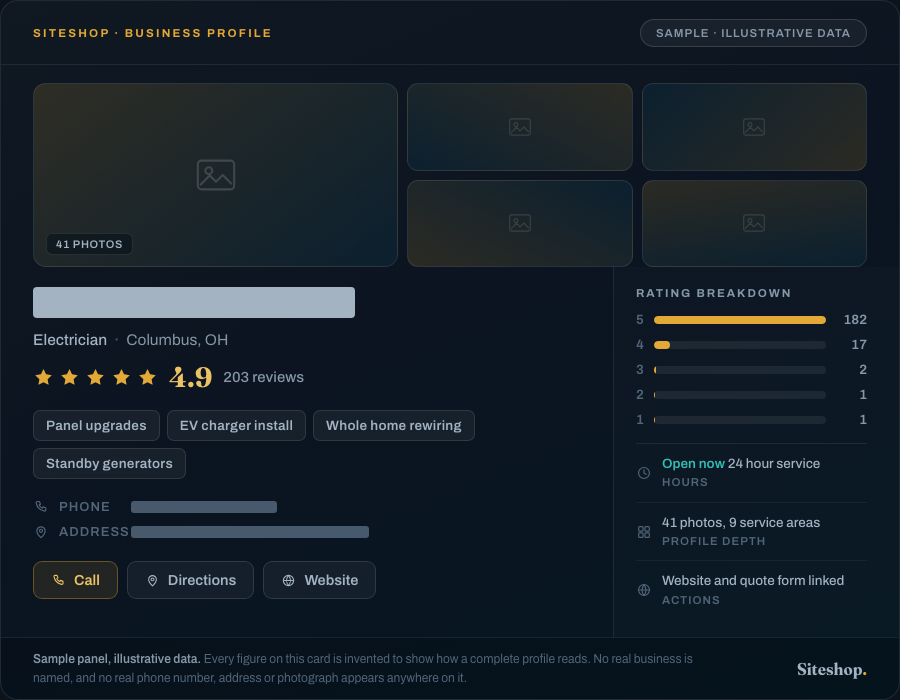
The short answer
What we actually fix first: 2 buyers, and 1 of them is worth far more.
Electrical demand splits cleanly. One buyer has no power and converts in minutes off the map pack. The other is pricing a service panel or an EV charger, reads for a week, then calls two companies. Almost every electrician site is built only for the first.
The emergency half behaves like plumbing. Rank in the map pack, load fast on a phone with one bar, put a tappable number where a thumb already sits, then answer when it rings. That is most of the work.
The panel upgrade half behaves like nothing else in the trades. It is a four-figure job the homeowner did not plan for, usually triggered by an inspection, a car purchase, or an addition. They want to know the price before they call anyone.
EV charger installs are the clearest open lane we see. The demand exists in every metro, the job pairs naturally with a panel upgrade, and the electricians who get it are usually the ones who built one honest page about it a couple of years ago.
The limit worth stating: this is still a real fight for the emergency terms. Companies with years of reviews already own the map pack in most cities, and no page changes that overnight.
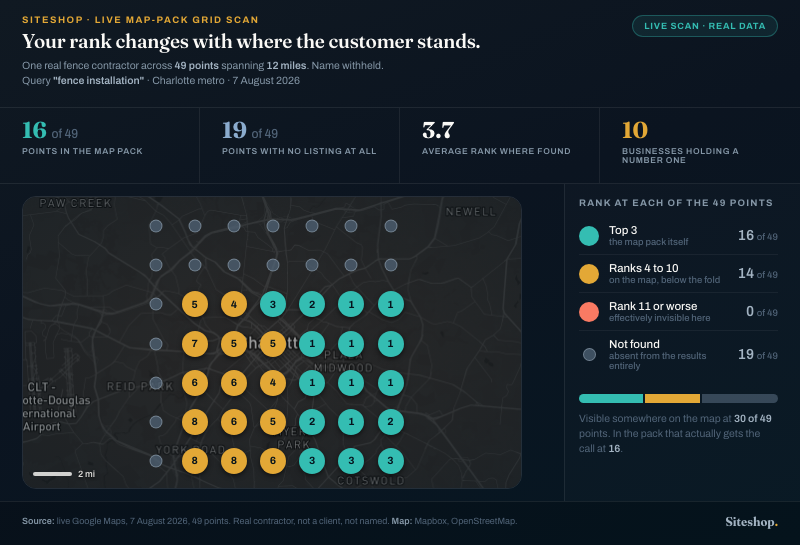
A real scan: 49 checkpoints, one live map lookup each. Green means the map pack, grey means invisible at that spot. This is how we measure the work, spot by spot, not by searching from the office chair.
Real query shapes
What your buyers actually say: 6 ways the call starts.
Electrical demand arrives in shapes that behave nothing alike. Two of them get decided in under a minute. Two of them take a week of reading and are worth several times more.
-
"The power's out, who can come now?"
The map pack decides it. Proximity, prominence, and reviews. The site barely gets a look.
-
"What does a panel upgrade run?"
Research intent on a four-figure job. Whoever publishes a range is on the shortlist.
-
"Can someone install an EV charger?"
Growing, high-ticket, and largely open ground, because most electricians never built the page.
-
"We've got sparks, is that dangerous?"
Panic intent, often after hours. Speed and someone actually picking up beat everything else.
-
"We're rewiring the whole house, what's involved?"
Long consideration, big ticket. Wants permits explained plus finished jobs to look at.
-
"The power went out again, do we need a generator?"
Seasonal spikes after outages. A standing page catches the spike; a post published during it does not.
These are the shapes electrical demand arrives in, not a transcript. Two of them get answered before the caller finishes the sentence. The other two need a page that actually explains the job, not a bullet promising to.
What arrives
What we build for an electrician: 6 pieces, in this order.
- 01
A panel upgrade page that names a range
What a 100 amp to 200 amp upgrade actually involves, why an inspection or a new range triggers it, what the permit adds, plus a price band. Most competitors have a single bullet where this page should be.
- 02
An EV charger install page
Level 2 versus level 1, what the panel has to support, and what the utility rebate process looks like locally. This is the page that pulls panel upgrade work in behind it.
- 03
The emergency route, fixed first
A tappable number visible without scrolling, pages that load in a couple of seconds on a mid-range phone, and no contact form standing between someone with no power and a call.
- 04
Town pages that are about the town
One page per town you want work from, carrying jobs done there and the permit office you actually deal with. Not a template with the town name swapped in thirty times.
- 05
Your Google profile worked every week
Categories, services, service area, and photos kept current, with fresh posts going out on a set schedule. For near-me electrical searches, this profile decides more of the outcome than the website does.
- 06
License and permit proof on the page
License number, insurance, and the fact that you pull permits and pass inspections, stated where a nervous homeowner can see it. Electrical is the trade where unlicensed work scares buyers most.
Fit
Who this fits: 4 signs it is you.
Electrical is one of the better trades for this work right now, because the highest-value jobs have the least competition on the page level. It still needs a business that can take the calls.
This is you if:
- You do residential service work, not only builder contracts, in towns you can name.
- You already install panels or chargers, or you want more of that work and less troubleshooting.
- Somebody answers the phone, including some of the time outside business hours.
- You could add crew capacity next quarter if the work showed up.
We will tell you no if:
- Nearly all your revenue comes from two builders on contract. This work is a diversification play there, not an urgent one.
- You need the phone ringing this week. That is a paid-ads job. This work compounds over months instead.
- You want a guaranteed map-pack position or a guaranteed lead count, which nobody can honestly sell you.
- Nobody at your company can take a call outside normal hours. Ranking a business that cannot answer moves the problem instead of fixing it.
How the work runs
What changes, month by month: the first 90 days.
- 01
Weeks 1 to 2: the free audit and the emergency fix
The 14-category audit, worked by hand on your site and your Google profile. Then the tappable number goes where a thumb rests, pages get faster, and the profile gets corrected and categorized properly. This is cheap work acting on demand that already exists.
- 02
Weeks 3 to 8: the high-ticket pages go up
Panel upgrades first, EV chargers second, then generators and rewiring. Each written to answer the cost question the search is really asking, not just to exist.
- 03
Month 2: near-me position starts to move
Profile posts, reviews, and the emergency-route fixes usually show up first in map-pack position for near-me searches, since that demand is already in the market. Pace varies by how contested your city already is.
- 04
Month 3 and on: the panel and charger pages earn rank
New service pages take longer to compound than profile work does. Most trades see meaningful movement on the high-ticket searches in the 3 to 6 month range, tracked on a grid so you can watch the radius rather than take our word for it.
Proof, not a pitch
Built by people who ran the truck first.
This program is built by an operator who ran a multi-state service business himself, not a marketing team improvising with a trade he has never worked. Read the operator history at /about.
- 300+
- Points in the Deep Audit, worked by hand
- 36
- Hyperlocal pages shipped in one build
- 14
- Categories in the Deep Audit, worked by hand
Every point listed in the report appendix
6 service areas × 6 services, same engagement
300+ points, $1,500
Search
What it costs: published, not quoted.
Most electrical companies start on the Local Engine at $1,500 a month, which covers the profile, the local page work, and a monthly report. What decides which engine fits is how many towns you want covered and how many of the high-ticket services get their own page.
Start on the Local Engine. Move up to the Market Engine when you are ready to own more than one town, and to the In-House Engine when you want a marketing department without the hire.
Every retainer tier, with what is in it| Tier | Price | What moves the number |
|---|---|---|
| Local Engine Get found where you already work: the map pack and the searches that ring the phone. | $1,500 per month | The price is flat. What changes is where the effort points: a harder town, or more services, means the same monthly hours aimed at fewer targets, and we say which before you sign. Page counts and posting frequency are agreed in writing per engagement, so scope cannot quietly drift. Not included. Multi-market page coverage, expanded listings and the AI-search program at full strength are the Market Engine. We would rather tell you when you are ready for it than sell it to you early. |
| Market Engine Own every town you serve: coverage pages, AI-search visibility, listings everywhere that counts. | $3,000 per month | How many markets and how many services. The price is flat, and the page program inside it is agreed up front, in writing, so the scope cannot quietly drift. Not included. Placements on other platforms, PR-grade link campaigns, social management, video creative and conversion testing are the In-House Engine, and it is capacity-capped. |
| In-House Engine Everything, run for you: search, content, placements, PR-grade links, social presence, video creative, conversion work, quarterly strategy. | $6,000 per month | Capacity, not scope creep. We run a small number of these engagements at a time so the work stays deep rather than spread thin across too many accounts. Not included. We still do not sell paid ad management, and we still will not commit to a monthly number of editorial links. Both get the same answer at every tier. This tier is also capacity-capped: a few seats, run deep, and we will say plainly if one is not open yet. |
Objections and questions
Questions we get asked: 6 answers.
These come up on nearly every first call with an electrical contractor, including the two where the honest answer is not the one that closes a sale.
Ask us something else How much does this cost?
Search work starts at $1,500 a month on the Local Engine, covering your Google profile managed weekly, pages built or improved every month, core listing cleanup, the review engine running, plus a monthly report in plain English. The Market Engine at $3,000 a month runs that work across every town you cover. If the site itself needs building, that is one-time at $1,500 or more, depending on how many services and towns need their own page.
Do I really need a separate page for EV charger installation?
Yes, and it is probably the highest-return page on the list. The demand exists in every metro now, it carries buying intent rather than curiosity, and the install almost always surfaces a panel question worth several times the charger job. A bullet on a services page answers nothing. A page that explains level 2 requirements, panel capacity, and what the local utility rebate involves earns the call from a competitor who never wrote one.
Is paid advertising or this better for an electrical company?
They do different jobs. Ads buy calls today, and every one of them costs real money whether or not it turns into a job, then production stops the day the spend stops. This work costs less over time, compounds, and leaves you owning the asset instead of renting it. The practical answer for most electricians is ads on emergency terms while the panel and charger pages mature, then dialing the ad spend back once those pages are pulling their own weight.
What does this cost me in my time?
Mostly a call or two a month, plus real photos when you have them. We write the pages, run the profile, and draft the review replies. What we cannot manufacture is proof: a job photo, a permit story, a customer who will leave a review. Those come from you.
Most of my work comes from general contractors. Should I bother with this?
Honestly, maybe later. If two builders keep your crews busy year round, this is not the emergency and we will say so. The argument for starting anyway is that builder relationships end with one phone call, and residential service work is the buffer that keeps the lights on when they do. Build the channel while you do not need it, or wait until you do.
How long until the phone starts ringing more?
The emergency-route fixes act on demand that already exists, so near-me position can move within a couple of months. The panel and charger pages take longer, usually 3 to 6 months, because they have to rank and the buyer takes weeks to decide. We track map-pack position on a grid from the first month, so you are watching movement rather than waiting on a promise.
Services
What we would actually run: the pieces that fit this trade.
Order matters more than the list for an electrician. The profile and the emergency route act on demand that exists today, while the panel and charger pages are the compounding half of the program.
- 01 Local SEO Ranking in the map pack for the towns you actually serve. Read more
- 02 Google Business Profile Management The profile worked weekly, not claimed once and forgotten. Read more
- 03 Landing Pages Single-service pages built to convert one kind of visitor. Read more
- 04 On-Page SEO Titles, structure, copy. All of it answering the query outright. Read more
- 05 Conversion Rate Optimization Find where the traffic you already have quietly leaks away. Read more
- 06 Review Management More reviews, answered fast, feeding the local pack. Read more
Other trades
6 more trades we work in: each one named for its own search.
Every trade below is a separate page, because every trade gets searched differently. If yours is not listed anywhere on the site, ask, because the list is shorter than the work.
- 01 Pest Control Marketing The recurring contract is the business. Sites keep burying it. Read more
- 02 Painting Contractor Websites Portfolio-led, priced honestly, bookable from a phone. Read more
- 03 Garage Door Marketing Same-day repair intent, plus the install job worth ten of it. Read more
- 04 Cleaning Company Marketing Residential and commercial are two funnels, not one page. Read more
- 05 Tree Service Marketing Removal, trimming, storm work: each earns its own search. Read more
- 06 SEO for Landscaping Weekly maintenance and $50k installs need separate routes in. Read more
Free snapshot · paid teardown
Send us your site: 300+ points, worked by hand.
A short, sharp look: the top handful of findings, scored, delivered by email. What's broken, in plain English.
Want the full punch list? The Deep Audit is $1,500: the same crawler and link indexes the top-tier agencies run, plus live map-pack checks town by town and AI-assistant citation checks almost nobody local does. 300+ points across all 14 categories, plus a prioritized 90-day plan. Credited in full toward your first month if you hire us within 60 days.
Snapshot delivered in a few business days
It's yours either way. Hand it to your own developer, or your own AI, and it still pays for itself. If you hire us, it costs you nothing.
Site & search audit · what we check
300+ points
- Crawl, indexation and site security 30 pts
- Duplicate signals, structure and internal links 39 pts
- Speed and Core Web Vitals 28 pts
- The experience on a phone 14 pts
- Money pages: content, depth and freshness 24 pts
- Structured data and the trust surface 20 pts
- Search demand and the keyword map 20 pts
- Google Business Profile 20 pts
- Reviews and reputation 16 pts
- Local presence: map results and directories 20 pts
- AI search and assistant citation 22 pts
- Link profile and authority 20 pts
- The operators beating you 22 pts
- Turning visits into calls, and counting them 24 pts
The Snapshot is the top handful of these, free. The Deep Audit is all 14 categories, 300+ points, scored, with a 90-day plan and the full point-by-point appendix. No account, no card either way.
Ready to stop losing customers to the guy with a better site?
Fifteen minutes, no discovery deck. We'll tell you what we'd build, what we'd rank, and what it costs. And if we're not the right fit, we'll say that too.