Industries · Pest Control
Pest control marketing: the recurring contract is the business.
A single roach treatment is revenue once. A quarterly plan is revenue for years. Yet the plan usually sits below the fold on a pricing page nobody reaches, while the one-time price does all the talking on the homepage.
The short answer
What we actually build for a pest control company: 1 funnel around the contract, not the callout.
The job is turning per-pest searches into signed plans. Each pest is its own search with its own panic level and its own price expectation. The site's job is to meet that specific search, then route the buyer to a plan instead of a single visit.
A termite search and a general exterminator near me search convert nothing alike. One is a structural finding with a real financial consequence attached. The other is an embarrassing emergency somebody wants handled fast. Both deserve their own page and their own language.
Mosquito and rodent work is seasonal, and it's where the recurring plan sells easiest, because the problem visibly comes back. A page that shows the return cycle sells a subscription better than any discount ever will.
Selling the plan first is a structural change, not a copy tweak: the plan priced above the one-time treatment, the comparison shown side by side, and the call to action on every pest page pointed at the contract.
The honest limit is that this is a smaller market than roofing or plumbing. The wins come from per-pest pages and steady map-pack position, built up over time, rather than from any one high-traffic term to chase.
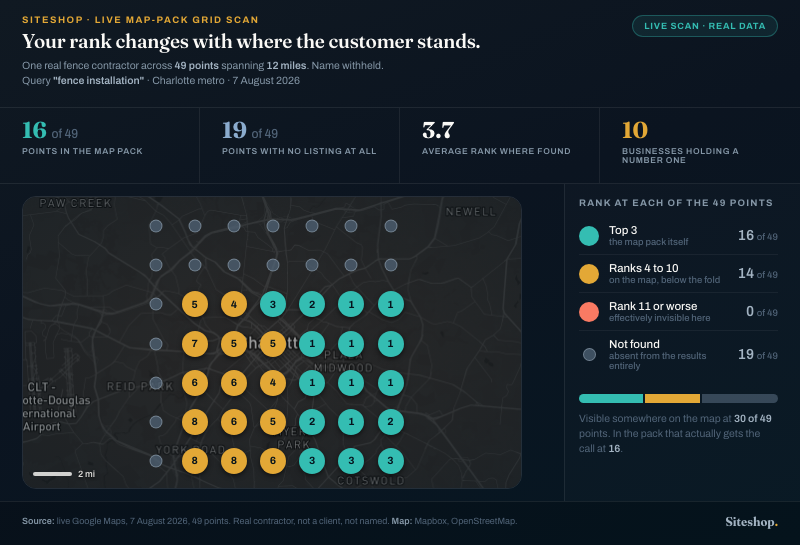
A real scan: 49 checkpoints, one live map lookup each. Green means the map pack, grey means invisible at that spot. This is how we measure the work, spot by spot, not by searching from the office chair.
Real query shapes
What your buyers actually type: 6 different pests, 6 moods.
Every pest is a different customer in a different mood. Urgency, price tolerance, and how much research they do before calling all shift by species.
-
exterminator near me
General intent, decided in the map pack. The highest volume of the set and usually the lowest job value.
-
termite inspection cost
Often triggered by a home sale or a lender. There's a deadline attached, and price sensitivity is low.
-
bed bug treatment {town}
Urgent and private. Buyers read heavily before calling and rarely price shop past two companies.
-
mosquito control service
Seasonal and naturally recurring. The shortest route between a search and a signed plan.
-
rodent removal
Panic plus structural worry. Exclusion work is the upsell, and it needs explaining on the page itself.
-
monthly pest control cost
This buyer has already decided on recurring and is choosing a company, not a service.
Six pests, six different buyers in six different moods. A page built for the termite call and the roach call at once serves neither one well.
What arrives
What we'd build for a pest control company: 6 pieces, in this order.
- 01
A page per pest
Termites, bed bugs, roaches, rodents, mosquitoes, ants, wasps. Each with its own explanation, its own price band, its own timeline. Seven searches answered instead of one generic services page.
- 02
The plan priced first
The recurring plan shown above the one-time treatment, with the yearly comparison spelled out. Most sites reverse this, which trains every visitor to buy the cheaper thing once and disappear.
- 03
Termites handled as their own business
Inspection, letter, treatment, warranty, plus the real-estate deadline that usually drives the search. It's a different buyer from the roach caller, and the page should read that way.
- 04
Town pages with real service detail
One page per town you run routes in, naming the pests that actually show up there. Real content per town, not a generic services page duplicated with the name swapped.
- 05
Your Google Business Profile worked every week
Categories, services, service area, photos, kept current. For near-me pest searches, the profile carries more weight than the website does.
- 06
Reviews requested while the technician's still in the driveway
A request that goes out the moment the job's done, plus replies that read like a person wrote them. Review count and reply rate both feed the map pack, and both are inside your control.
Fit
Who this fits: 4 signs it's you.
Pest control is a route business, so the value of this work shows up in plan sign-ups per zip code more than in raw call volume. That changes what we build and what we report on.
This is you if:
- You sell recurring plans and want a bigger share of new customers landing on one.
- You have route capacity in specific zip codes you can name.
- You do termite or bed bug work and know those jobs are worth defending with their own page.
- You're tired of competing on a one-time price against a franchise with a bigger ad budget.
We will tell you no if:
- Your routes are already full everywhere you operate. More calls make that worse, not better.
- You only sell one-time treatments with no plan to offer a contract. The funnel on this page has nothing to route toward.
- You want a guaranteed number of sign-ups. Nobody can honestly promise you one.
How the work runs
What changes, month by month: 4 milestones.
- 01
The first two weeks
The plan flipped to the front of the funnel, the profile corrected, tracking wired up. Cheap work, and usually the single change that moves revenue the most on its own.
- 02
Around day 30
The funnel and profile fixes act on demand that's already searching for you. Most operators start seeing that show up in sign-ups somewhere in this window.
- 03
Around day 60
New pest pages start showing up in search, highest-value species first, usually termites and bed bugs. How fast depends on how contested your specific zip codes are.
- 04
Day 90 and beyond
Profile posts, reviews, pages and citations running on a monthly rhythm, with map-pack position tracked on a grid across your route area so coverage is something you can see, not something we tell you.
Proof, not a pitch
Built by people who ran the truck first.
We've run route-dependent service businesses ourselves, which is why the difference between a booked recurring route and a calendar of one-off jobs isn't theory to us.
- 300+
- Points in the Deep Audit, worked by hand
- 36
- Hyperlocal pages shipped in one build
- 14
- Categories in the Deep Audit, worked by hand
Every point listed in the report appendix
6 service areas × 6 services, same engagement
300+ points, $1,500
Search
What it costs: published, not quoted.
Most pest control operators start on the Local Engine at $1,500/mo, covering one route area with the profile and pages worked monthly. Operators running routes across several towns usually move to the Market Engine at $3,000/mo, or the In-House Engine at $6,000/mo once they want the whole marketing seat run for them.
Start on the Local Engine. Move up to the Market Engine when you are ready to own more than one town, and to the In-House Engine when you want a marketing department without the hire.
Every retainer tier, with what is in it| Tier | Price | What moves the number |
|---|---|---|
| Local Engine Get found where you already work: the map pack and the searches that ring the phone. | $1,500 per month | The price is flat. What changes is where the effort points: a harder town, or more services, means the same monthly hours aimed at fewer targets, and we say which before you sign. Page counts and posting frequency are agreed in writing per engagement, so scope cannot quietly drift. Not included. Multi-market page coverage, expanded listings and the AI-search program at full strength are the Market Engine. We would rather tell you when you are ready for it than sell it to you early. |
| Market Engine Own every town you serve: coverage pages, AI-search visibility, listings everywhere that counts. | $3,000 per month | How many markets and how many services. The price is flat, and the page program inside it is agreed up front, in writing, so the scope cannot quietly drift. Not included. Placements on other platforms, PR-grade link campaigns, social management, video creative and conversion testing are the In-House Engine, and it is capacity-capped. |
| In-House Engine Everything, run for you: search, content, placements, PR-grade links, social presence, video creative, conversion work, quarterly strategy. | $6,000 per month | Capacity, not scope creep. We run a small number of these engagements at a time so the work stays deep rather than spread thin across too many accounts. Not included. We still do not sell paid ad management, and we still will not commit to a monthly number of editorial links. Both get the same answer at every tier. This tier is also capacity-capped: a few seats, run deep, and we will say plainly if one is not open yet. |
Objections and questions
Questions we get asked: 6 answers.
These come up on nearly every first call with a pest control operator, including the one about whether this trade is worth the effort at all.
Ask us something else How much does pest control marketing cost?
The Local Engine starts at $1,500/mo and covers the Google Business Profile, pages built or improved monthly, the review engine, and a monthly report. The Market Engine at $3,000/mo covers multiple route areas and adds social profiles, link outreach, and conversion testing, which is the tier that gets a page per pest built at pace. A new site is a one-time cost starting around $1,500. A free, no-obligation look at what's costing you sign-ups is also on the table before you spend anything.
Should I lead with the plan or the one-time treatment?
The plan, on every page, with the one-time price shown underneath as the comparison. A buyer who lands on your roach page in a panic will take whatever's easiest to click, so make the contract the easy click. Show the yearly math side by side and say plainly what the plan includes that a single visit doesn't. Sites that bury the plan train every visitor to buy once and disappear.
Do termites and bed bugs really need their own pages?
Yes, because they're different businesses wearing the same uniform. A termite search is usually attached to a home sale with a lender deadline, so it wants inspection detail, the letter, warranty terms. A bed bug search is urgent and private, so it wants discretion and clear preparation steps. Putting both in one paragraph on a services page means ranking for neither and reassuring nobody.
How long until sign-ups pick up?
Funnel and profile fixes act on demand already searching for you, so those can show up within the first month or two. New per-pest pages compound over a few months on top of that. We track map-pack coverage on a grid across your route area from day one, so you can watch it before the revenue shows up.
Do I have to write anything myself?
No. We write the pages and draft the review replies. You approve what goes out and run the routes.
I get plenty of calls from my truck wraps and door hangers. Why change?
If your routes are full, don't change anything. That's a genuine answer, and we give it more often than you'd think. The case for search work is route density rather than raw call count: wraps and hangers produce scattered customers across a wide area, while ranking well in specific zip codes clusters your stops and cuts drive time. If your trucks are already tight and busy, spend the money elsewhere.
Services
What we would actually run: the pieces that fit this trade.
For a route business the profile and the map pack come first, because that's where a near-me search is decided. The per-pest pages then do the work of turning those calls into signed plans.
- 01 Local SEO Ranking in the map pack for the towns you actually serve. Read more
- 02 Google Business Profile Management The profile worked weekly, not claimed once and forgotten. Read more
- 03 Conversion Rate Optimization Find where the traffic you already have quietly leaks away. Read more
- 04 Review Management More reviews, answered fast, feeding the local pack. Read more
- 05 Landing Pages Single-service pages built to convert one kind of visitor. Read more
- 06 On-Page SEO Titles, structure, copy. All of it answering the query outright. Read more
Other trades
6 more trades we work in: each one named for its own search.
Every trade below is a separate page, because every trade gets searched differently. If yours is not listed anywhere on the site, ask, because the list is shorter than the work.
- 01 Painting Contractor Websites Portfolio-led, priced honestly, bookable from a phone. Read more
- 02 Garage Door Marketing Same-day repair intent, plus the install job worth ten of it. Read more
- 03 Cleaning Company Marketing Residential and commercial are two funnels, not one page. Read more
- 04 Tree Service Marketing Removal, trimming, storm work: each earns its own search. Read more
- 05 SEO for Landscaping Weekly maintenance and $50k installs need separate routes in. Read more
- 06 Pressure Washing Marketing Seasonal, visual, decided on a phone in about four seconds. Read more
Free snapshot · paid teardown
Send us your site: 300+ points, worked by hand.
A short, sharp look: the top handful of findings, scored, delivered by email. What's broken, in plain English.
Want the full punch list? The Deep Audit is $1,500: the same crawler and link indexes the top-tier agencies run, plus live map-pack checks town by town and AI-assistant citation checks almost nobody local does. 300+ points across all 14 categories, plus a prioritized 90-day plan. Credited in full toward your first month if you hire us within 60 days.
Snapshot delivered in a few business days
It's yours either way. Hand it to your own developer, or your own AI, and it still pays for itself. If you hire us, it costs you nothing.
Site & search audit · what we check
300+ points
- Crawl, indexation and site security 30 pts
- Duplicate signals, structure and internal links 39 pts
- Speed and Core Web Vitals 28 pts
- The experience on a phone 14 pts
- Money pages: content, depth and freshness 24 pts
- Structured data and the trust surface 20 pts
- Search demand and the keyword map 20 pts
- Google Business Profile 20 pts
- Reviews and reputation 16 pts
- Local presence: map results and directories 20 pts
- AI search and assistant citation 22 pts
- Link profile and authority 20 pts
- The operators beating you 22 pts
- Turning visits into calls, and counting them 24 pts
The Snapshot is the top handful of these, free. The Deep Audit is all 14 categories, 300+ points, scored, with a 90-day plan and the full point-by-point appendix. No account, no card either way.
Ready to stop losing customers to the guy with a better site?
Fifteen minutes, no discovery deck. We'll tell you what we'd build, what we'd rank, and what it costs. And if we're not the right fit, we'll say that too.